Gardens, architecture, sculpture and fabriques, especially of the baroque kind. By David R. Marshall of Montacute Pavilion, Daylesford: the ultimate romantic getaway. https://www.dayget.com.au/montacute-pavilion-and-gardens
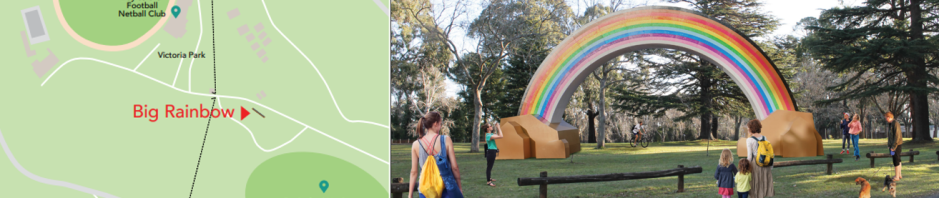
Recently it was announced that Daylesford would get the Big Rainbow Arch. Hepburn Shire Council opened a survey asking for opinions on options for siting.[1]
Several current councillors make a lot of noise about consultation, and on issues like The Rex focus solely on ‘public consultation’ or the lack of it rather than on viable future action. But councillors are silent on the big question: whether this structure should be accepted at all. The council website states that ‘Daylesford has been selected as the home of the Big Rainbow by popular vote’, but this was not a popular vote of ratepayers of residents of the shire. Rather it was a vote of the LGBTQIA+ community organised by Tinder, the dating app.[2] Council then threw it support behind the project because ‘[w]e have a history of being strong supporters of our LGBTIQA+ residents and visitors.’ The use of the inclusive pronoun ‘we’ seems deliberately vague in its referent: is it Council or the Daylesford community?[3] One cannot oppose this proposal because to do so is to be anti LGBTQIA+, although a few brave souls have done so on social media, pointing out that to object to the structure does not necessarily mean objecting to what the structure stands for. But who believes this? Almost no-one. This is because art is now reduced to symbolism; it is the only dimension it now has. One cannot respond to the structure on aesthetic, art historical, or any other grounds other that what it stands for: support for the LGBTQIA+ community.
This is the inverse of destroying a beautiful eighteenth century portrait statue because one disapproves of the fact that its subject had a connection with slavery somewhere along the line. One has to accept the creation of something non-beautiful because what it is designed to symbolise is approved of.
It also represents the death of liberalism. An old fashioned liberal believed, like Edward VII, that you should be able to do what you like so long as it didn’t frighten the horses. But those who have benefited most from the liberal attitude are now dictatorial. The Taliban destroyed the Bamiyan Buddhas because in spite of being impressive creations that glorified humanity they stood for something they did not like, but, being opposed to imagery as such, they stopped short of installing a huge eyesore in its place. But here we are not opposed to imagery; far from it.
The trivialisation of contemporary art is to blame. Some of the most successful – in terms of being bought for large sums by art museum directors – pieces of contemporary art are predicated on a very simple, indeed simplistic idea: make a small thing big (and very bright and if possible shiny) and call it Art. Think giant milk crates or giant balloon dogs or giant mirrored Dresden statuettes. In the case of the rainbow arch, what was once as a flag in a window is given artistic significance by being made huge, gaudy and permanent.
There was a time that the sophisticated poured scorn on the uneducated vulgarity of the Queenslanders who created a Big Pineapple. (Hamilton in Victoria, or its termites, got rid of its Big Wool Bale some years ago, although Glenrowan still has its Big Ned Kelly.) But it would seem that there are few such sophisticates left. A new version of the ‘Big Pineapple’ was designed by a group of heavy-duty architectural firms.[4] ‘Big Things’ have been academicised and hence legitimised as ‘outdoor cultural objects which serve to construct and assert the identity of a town or area, and they have also been described as one of Australia’s most distinctive home-grown forms of folk art’.[5] To judge from the easy acceptance of the Big Rainbow on local social media, for millennials and Gen-Z, such big structures, as tourist destinations or objects in art museum foyers, are simply normal: they are Art.
But can one make an aesthetic case for the Big Rainbow? No. There is no design for the actual structure. There is only a concept, because that is all there is here. The form of the realisation of this concept is irrelevant, because form means nothing. Art history is predicated on the assumption that the fact that a statue represents Hercules is merely a given; what matters is what form that Hercules or Venus takes. From there the discourse begins – often along the lines that ‘this Hercules is modelled on the antique Farnese Hercules type … the Farnese Hercules was in such-and-such a place and accessible as a model to the artist, who changed things in such-and-such a way for such-and-such a purpose to such-and-such an effect.’ Or ‘this figure of Samson takes the form of an antique Hercules, the first instance of Renaissance classical revival …’. Hence the Big Rainbow asserts the death of Art History, and is the reason why one needs to assert, and keep asserting: ‘Non idea sed res’. Any fool can have an idea: culture resides in the form that that idea takes.
[2] From the Hepburn Shire website: ‘How was Daylesford selected as the new home of the Big Rainbow? After receiving thousands of submissions, Tinder worked in close collaboration with their panel of community advisors and experts within the LGBTQIA+ and First Nations communities to curate the shortlist of four nominated towns to possibly house the Big Rainbow. / From these four towns, the public then submitted over 16,000 votes to help find the leading town – making Daylesford the new home of the Big Rainbow. They also worked closely with Council to ensure there was an existing history of support for the LGBTQIA+ community and desire to be the home of the Big Rainbow. It’s important to ensure that the Big Rainbow is loved, respected and taken care of at its new home.’
[3] ‘From the Hepburn Shire website: ‘Why was Council keen to be involved in the Big Rainbow project? The Big Rainbow is Australia’s first BIG landmark celebrating regional LGBTQIA+ pride and inclusion, designed with members of the LGBTQIA+ and First Nations communities. We have a history of being strong supporters of our LGBTIQA+ residents and visitors.’
[5]https://en.wikipedia.org/wiki/Big_Pineapple. ‘Big Things are large advertising objects, usually in the form of the item they are advertising, and are loosely defined as being at least twice the size of the object they represent and at least twice human size. Big Things have been called outdoor cultural objects which serve to construct and assert the identity of a town or area, and they have also been described as one of Australia’s most distinctive home-grown forms of folk art.’
A garden is both a real place, and a cloud of possibilities. What you will find here will be both something real, and something that may or may not become real. For this reason you will find no map: Instead you will meet fragments, part real, part possible.
The Villa Castagna Daylesford website operates under the Creative Commons Attribution-Non Commercial-NoDerivs 3.0 licence. For a summary account of the terms of this license see Creative Commons
 Villa Castagna
How a Rainbow Arch Declares the Death of Art History
Recently it was announced that Daylesford would get the Big Rainbow Arch. Hepburn Shire Council opened a survey asking for opinions on options for siting.[1]
Several current councillors make a lot of noise about consultation, and on issues like The Rex focus solely on ‘public consultation’ or the lack of it rather than on viable future action. But councillors are silent on the big question: whether this structure should be accepted at all. The council website states that ‘Daylesford has been selected as the home of the Big Rainbow by popular vote’, but this was not a popular vote of ratepayers of residents of the shire. Rather it was a vote of the LGBTQIA+ community organised by Tinder, the dating app.[2] Council then threw it support behind the project because ‘[w]e have a history of being strong supporters of our LGBTIQA+ residents and visitors.’ The use of the inclusive pronoun ‘we’ seems deliberately vague in its referent: is it Council or the Daylesford community?[3] One cannot oppose this proposal because to do so is to be anti LGBTQIA+, although a few brave souls have done so on social media, pointing out that to object to the structure does not necessarily mean objecting to what the structure stands for. But who believes this? Almost no-one. This is because art is now reduced to symbolism; it is the only dimension it now has. One cannot respond to the structure on aesthetic, art historical, or any other grounds other that what it stands for: support for the LGBTQIA+ community.
This is the inverse of destroying a beautiful eighteenth century portrait statue because one disapproves of the fact that its subject had a connection with slavery somewhere along the line. One has to accept the creation of something non-beautiful because what it is designed to symbolise is approved of.
It also represents the death of liberalism. An old fashioned liberal believed, like Edward VII, that you should be able to do what you like so long as it didn’t frighten the horses. But those who have benefited most from the liberal attitude are now dictatorial. The Taliban destroyed the Bamiyan Buddhas because in spite of being impressive creations that glorified humanity they stood for something they did not like, but, being opposed to imagery as such, they stopped short of installing a huge eyesore in its place. But here we are not opposed to imagery; far from it.
The trivialisation of contemporary art is to blame. Some of the most successful – in terms of being bought for large sums by art museum directors – pieces of contemporary art are predicated on a very simple, indeed simplistic idea: make a small thing big (and very bright and if possible shiny) and call it Art. Think giant milk crates or giant balloon dogs or giant mirrored Dresden statuettes. In the case of the rainbow arch, what was once as a flag in a window is given artistic significance by being made huge, gaudy and permanent.
There was a time that the sophisticated poured scorn on the uneducated vulgarity of the Queenslanders who created a Big Pineapple. (Hamilton in Victoria, or its termites, got rid of its Big Wool Bale some years ago, although Glenrowan still has its Big Ned Kelly.) But it would seem that there are few such sophisticates left. A new version of the ‘Big Pineapple’ was designed by a group of heavy-duty architectural firms.[4] ‘Big Things’ have been academicised and hence legitimised as ‘outdoor cultural objects which serve to construct and assert the identity of a town or area, and they have also been described as one of Australia’s most distinctive home-grown forms of folk art’.[5] To judge from the easy acceptance of the Big Rainbow on local social media, for millennials and Gen-Z, such big structures, as tourist destinations or objects in art museum foyers, are simply normal: they are Art.
But can one make an aesthetic case for the Big Rainbow? No. There is no design for the actual structure. There is only a concept, because that is all there is here. The form of the realisation of this concept is irrelevant, because form means nothing. Art history is predicated on the assumption that the fact that a statue represents Hercules is merely a given; what matters is what form that Hercules or Venus takes. From there the discourse begins – often along the lines that ‘this Hercules is modelled on the antique Farnese Hercules type … the Farnese Hercules was in such-and-such a place and accessible as a model to the artist, who changed things in such-and-such a way for such-and-such a purpose to such-and-such an effect.’ Or ‘this figure of Samson takes the form of an antique Hercules, the first instance of Renaissance classical revival …’. Hence the Big Rainbow asserts the death of Art History, and is the reason why one needs to assert, and keep asserting: ‘Non idea sed res’. Any fool can have an idea: culture resides in the form that that idea takes.
[1] https://participate.hepburn.vic.gov.au/big-rainbow#faqModal-3225-281-a
[2] From the Hepburn Shire website: ‘How was Daylesford selected as the new home of the Big Rainbow? After receiving thousands of submissions, Tinder worked in close collaboration with their panel of community advisors and experts within the LGBTQIA+ and First Nations communities to curate the shortlist of four nominated towns to possibly house the Big Rainbow. / From these four towns, the public then submitted over 16,000 votes to help find the leading town – making Daylesford the new home of the Big Rainbow. They also worked closely with Council to ensure there was an existing history of support for the LGBTQIA+ community and desire to be the home of the Big Rainbow. It’s important to ensure that the Big Rainbow is loved, respected and taken care of at its new home.’
[3] ‘From the Hepburn Shire website: ‘Why was Council keen to be involved in the Big Rainbow project? The Big Rainbow is Australia’s first BIG landmark celebrating regional LGBTQIA+ pride and inclusion, designed with members of the LGBTQIA+ and First Nations communities. We have a history of being strong supporters of our LGBTIQA+ residents and visitors.’
[4] Peddle Thorp and Harvey, Paul Luff, and Gary Smallcombe and Associates. https://www.bigpineapple.com.au/
[5] https://en.wikipedia.org/wiki/Big_Pineapple. ‘Big Things are large advertising objects, usually in the form of the item they are advertising, and are loosely defined as being at least twice the size of the object they represent and at least twice human size. Big Things have been called outdoor cultural objects which serve to construct and assert the identity of a town or area, and they have also been described as one of Australia’s most distinctive home-grown forms of folk art.’
Share this:
Related