
At Harold Peto’s Iford Manor by there is a neo-Romanesque pavilion called the Casita on the upper terrace. Its wonderfully weathered architrave is supported on double stone columns with fused capitals (apparently pink Verona marble dating from c. 1200) with an impost block between. This impost block appears to be composed of three pieces of wood dovetailed (or rather straight-tailed) together, as if the side pieces were hinged on the central one. One begins by wondering why Peto has done this. The purpose of an impost block is to spread the load between architrave and capital, a task which an intact piece of wood would do better, although in the end any structural difference would be negligible. Perhaps his pieces of wood were too short? Then one realizes that the grain of the wood continues through all three pieces of wood: it is in fact a single piece of wood after all. The wood has been carved in such a way as to give the impression that there are ‘dovetails’: they are fictive. What game is Peto playing here? Is it a sophisticated neo-Mannerist trick? Does it have a precedent in Romanesque architecture? Whatever the reason, it is a delightful conceit. If forces us to swivel the hinged sides of the impost in our mind’s eye, and that makes it very interesting for the way it manipulates the spectator’s response. Also intriguing is the profile of the side pieces (which we must now call ends) of the impost block, which are more Chinese than Romanesque. And how did his carpenter make it? Cutting thick pieces of wood is a nightmare. The only tool which comes near is a bandsaw, and even a bandsaw will not do such sharp curves as these. The deep hollows would have been drilled; the rest probably involved templates, or outlines on either side and a series of straight sawcuts, with lots of chiselling.
Robin Whalley’s book on Peto states that the ‘highly decorative architrave’ is ‘probably of Venetian origin’. I am not clear whether he means by this the style is Venetian, and the manufacture local, or that the wood is actually old and Venetian (if follows mention of the columns being of Verona marble). Peto apparently was thinking of Spain, as H. Avray Tipping in 1922 expained that a casita was ‘a Spanish form of loggia’, but Whalley says ‘aspects of its construction are borrowed mainly from Italy’. (Robin Whalley, The Great Edwardian Gardens of Harold Peto. From the archives of Country Life, London: Aurum Press, 2007, p. 177.)
-
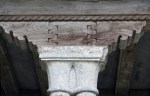
- Wooden impost at Iford Manor
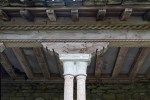


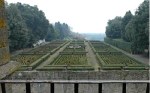
 Villa Castagna
The Impossibility of Australian Architectural Connoisseurship
‘An Australian, however well-informed, simply cannot distinguish between a piece of Trust House timbering and a genuine Tudor building; an Englishman however uncultured knows at once …’. [Evelyn Waugh to John Betjeman, cited in A.N. Wilson’s Biography of Betjeman, 2007, p. 170. Actually an analogy with Catholics and Anglo-Catholics all looking alike to Betjeman, according to Waugh.]
Evelyn Waugh having thus established the impossibility of an Australian engaging in architectural connoisseurship, it may be unwise to embark on this theme. And perhaps he is right, given how dreadful is the builder’s mock Federation, worse perhaps than the mock-Tudor thirties semi-detached so hated by early twentieth-century British architectural aesthetes.
A builder was describing to be a building he had recently clad in blackbutt, and how it expanded and buckled with time. The modernist preoccupation with new materials has carried over into Australian domestic housing, where the aspirational who want to make a statement feel it is necessary to experiment with untried materials. There is a lot of this in Grand Designs too. But in the end aesthetic pleasure derives from getting the shape right. Better to focus on shape and appearance, and use established materials. Weatherboard is good example of such a material. Being basically the same technique used for boats from the Vikings onwards, it can flex and bend and still work even if the structure behind is falling apart and the stumps are gone. And the regular parallel lines provide a pleasing enlivening of the surface, helped by the necessary small irregularities.