Portmeirion 3. How Serious is Portmeirion?

The trauma of the First World War seems to have manifested itself in the ‘silly ass’ artistic culture of the 1920s. Novelists like Margery Allingham, and even Dorothy L. Sayers, created their detective heroes as upper class twits who took nothing seriously, at least on the surface, and they spent the rest of their writing careers trying to escape this straitjacket by making them increasingly serious. Even Poirot, although Belgian, fits this mould. A musician-painter like Lord Berners was an extreme case, and it even affected a later generation like Rex Whistler, although all the signs are there that it he has survived the Second World War his art would have taken a more earnest turn.

The creation of Portmeirion can similarly be construed as a manifestation of this culture, a fundamentally frivolous endeavour designed to purge the trauma of the trenches. Clough was reportedly a fairly jokey man, but although he served on the Western Front with distinction one does not get the impression that it changed him as an architect, and his jokiness seems to have been innate and genuine, rather than a defensive face. In any case he was formed psychologically before the war began.

The question of the seriousness of Portmeirion goes deeper than this. It is not that Clough did not take it seriously, but that British culture then, and still today, finds such a project hard to swallow, and that one defence is to laugh it off as mere whimsy.

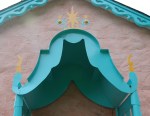
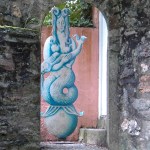
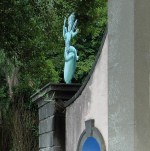
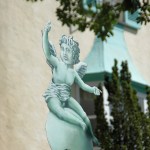
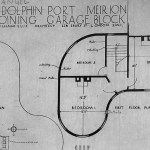
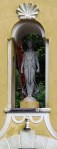
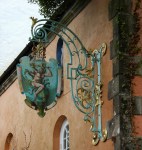
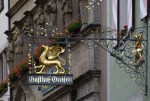
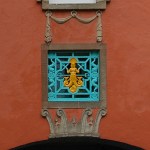
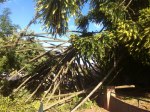
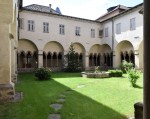
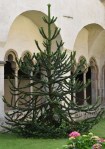
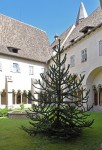
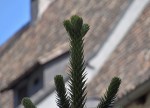
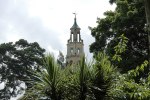
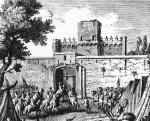
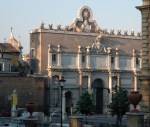
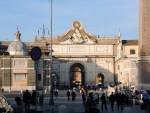
The architectural features that are the touchstone for this issues are the shaped pieces of sheet metal (Fig. 1), often painted illusionistically, that in any ‘serious’ building, such as a Baroque palace, would have been rendered fully in three-dimensions out of a noble material like stone (Figs 2, 3, 4). Of course, plenty of Baroque buildings had illusionistically painted doorways and so forth, and to this day Anglos often respond negatively to them, and the word ‘fake’ will quickly surface. It is this base-level attitude that, it seems to me, underpins responses to Portmeirion from the 1920s to the present, and that Clough had to address in one way or another.


The question of money comes into it. Are these just cheap substitutes created when there was no money for the real thing? Or is the material from which they are made their point? Was Clough making a joke, or being witty, in making them of thin hard metal rather than stone? If they were made with noble materials in three dimensions would they been too earnest, too old-world serious? Or was he pursuing a vision of what these features purported to be, and this was the only way they could be realised?

I am inclined to believe that the use of sheet metal was more to do with economy than jokiness. If your vision is a Baroque one, which requires three-dimensionality, the hardest thing to realise is the details. If you can acquire vases and so forth through salvage, well and good; but the reality is the labour costs of creating such features is immense, and was possibly only in a Baroque princely economy. Even today one if you want such features you are limited to a restricted range of reconstituted items made by firms like Haddonstone. Portmeirion was a low-budget operation from the beginning: it was a vision to be realised in bits and pieces by whatever means available. The buildings are quite cheaply made; the Angel has a solid double brick ground floor, but the upper story is lath and plaster on timber studs (Fig. 5). Only the towers (the Campanile and the lighthouse) look like they are more solidly constructed, but they remain quite small.

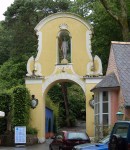
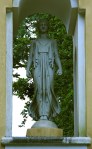
A way of testing the issue is to look at the Triumphal arch (Fig. 7). This is a late building, made in 1962–63, and in the opening we find, not an illusionistally painted sheet metal statue as we have come to expect from the rest of Portmeirion, but a three-dimensional one (Fig. 8). In fact this is the wooden model for a set of lead statues on the balcony of a house in Park Lane in London, erected in about 1830. The statues, being so heavy, threatened to bring down the balcony, according to an account in 1909. The statue is an imitation of a Greek archaic type of statue, which has nothing historically to do with the Cloughian Dutch gables on either side historically, and like much at Portmeirion is opportunistic (Fig. 9). But frankly it looks so much better than the painted steel details.

But does it mean, then, that Clough’s vision would be more fully realised if the sheet metal statues were to be replaced with three-dimensional ones? At this point the issue of authenticity raises its ugly head. One could imagine the objections that the conservation and planning authorities would raise if this were proposed. Most of the buildings at Portmeirion have Grade II conservation status, and some acquired this within a few years of being built, during Clough’s lifetime, including this Triumphal Arch, which received it in 1971, eight years after it was built. Grade II status is not particularly special (in the strange British system, Grade I and Grade II* are close together and quite special; Grade II is everything else.) Already then Portmeirion was changing in status from one man’s folly to an historic monument. Only Clough could have made this change, but even for Clough, and indeed for anyone in his situation, the simple passage of time would have woven tendrils of constraint around his constructions, so that what he might have done back then if he had had the money is no longer the point. The building has acquired a life of its own. His successors, fully enmeshed in the bureaucracy of preservation, almost certainly cannot. And with some reason. The painted sheet metal details has been part of the experience of Portmeirion for generations, and it would well be a cultural loss to lose them.

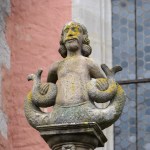
The concept of authenticity provides another way into addressing the seriousness or lack of it of Portmeirion. Here we see a design for the Peacock shop sign (c. 1955) (Fig. 10) and a sign showing Hercules and the Hydra on the Town Hall (Fig. 11), like one in the German Medieval-Renaissance town of Rothenburg-ob-der-Tauber (Fig. 12). We know that this sign was created by Clough and others to attract the (probably momentary) interest of a tourist. The shop sign in Rothenburg is not necessarily old, and could even be younger that Clough’s, but let us suppose it indeed dates from ‘the olden times’. Another example might be a statue of a Triton on a column at Rothenburg (Fig. 13), which is strikingly like the Portmeirion logo, a mermaid, exemplified by the cast-iron panels salvaged from the Sailor’s Home in Liverpool that are distributed around the village (Fig. 14).

Such signs as those at Rothenburg were, one supposes, originally created to play a practical, but also artistic, role within the functioning of an ‘authentic’ town. A cultural critic today may decry the fact that for the tourist that sign is only of passing interest within the touristic experience, an experience that is, by definition, inauthentic. Clough’s Hercules and the Hydra shop sign is therefore either doubly inauthentic, in that it was not only used, but created, to contribute to the touristic experience, or else is truly authentic in that there is no disjunction between the role it now plays and the role that it was created to fill.

And is Portmeirion also inauthentic as a touristic experience? The point of going to Rothenburg is to experience what it would be like to live in a town crated by an alien culture. The original inhabitants are long gone, and everyone is a tourist like yourself, but surely the point of the touristic experience is that one’s presence within a physical environment that was created by those people long ago allows you to imaginatively engage with that lost world (or worlds). But at Portmeirion there is no such world. Its buildings and signs were created for you. It may look and feel like Rothenburg, but there is nothing there. It is not a village, and never was; it is just a hotel with themed buildings.

Is there any way out of this? In order to find one we need to sidestep the whole tourism-theme park-authenticity discourse. We need to replace it with something else. Two such possibilities are the cult of the artist, and Platonism. House museums do very well on the cult of the artist: the Watts House and the Villa Stuck are cases in point. We go to the Watts chapel (actually created by his wife) for the Wattses, not for the Celtic-Romanesque world to which it purports to belong (Fig. 15). The cult of Clough is undoubtedly there are Portmeirion, but does anyone go there to drink in his creative imagination? A few perhaps, but not enough. His supposed lack of seriousness gets in the way, as does the question of whether he was a great architect or not. I suspect that few people say, as they do of Michelangelo: great genius, great man, lets go and look at the Sistine Ceiling. More often they arrive at Portmeirion and say: what’s going on? Who is responsible for this odd creation?

The philosophical foundations of the cult of the artist is Platonism. That is to say, beauty. Perfect forms—the ideal—are divine, but unattainable; the works of the artist bring us close to that perfection, and the greater the artist the closer we come. But we need not focus on the artist. We need only ask ourselves whether, and to what degree, a thing, or place, is beautiful. In many ways that is what the tourist does. He or she gets tired of having the history of Rothenburg beaten into them, apart from a few framing anecdotes. They just want to admire it.

The search for beauty involves criticism. Because the end goal is perfection, the first question a Platonic idealist asks of something is the extent to which it fails to be perfect. What is wrong with it? How can it be improved? Baroque artists like Domenichino had the Platonist mindset and believed that in creating a work of art one needed to start with the best model available and improve upon it, in this way approaching more closely the ideal. To improve on something you need to make it better, which means you need to identify what is not as good as it might be. You need to criticise. Unfortunately, a critical mindset is alien to contemporary thinking. There is no such thing as criticism of contemporary art, for example, because there are no criteria by which to criticise it. An artist gains his or her reputation by a process of gaining approval by tastemakers who do not have to give reasons why. Our obsession with identity politics means that any criticism of what someone has done is considered a personal insult to that person’s gender, race, or identity. What right do you have to say that anything I have done is deficient in any way?

Because of this, the tourist in Rothenburg is unlikely to indulge in useful criticism of the place, beyond saying that they loved it (‘how cute was that!’) or hated it (‘oh, it’s so tacky and touristy. Lets go to Bolivia instead’). The idealist critic, though, will attempt to articulate why that stretch of buildings is beautiful, which requires that they also point out the building half way along that rather spoils things and could have been improved. Authenticity and history are beside the point: the Platonic idealist is only concerned with the relationship between the mundane thing and the perfect Form.

The same applies with Portmeirion. If all that matters is its beauty, the circumstances of its creation become secondary; moreover, there is no reason to freeze its form in time, no point in searching for the original, historic Portmeirion. Rather we should be pushing to improve it. That shop sign, is it as good as the one in Rothenburg? This question generates useful answers. ‘At first sight it may look less spectacular, but there is something in that combination of wrought iron with turquoise and gold paint that is pure Clough, and in its own way superior to what those Germans did in Rothenburg’. Does this streetscape work? What can be done to improve it? This line of argument is one that Clough would embrace enthusiastically, having once been given the task of improving the streetscape of an English village called Cornwell. I am reminded of how alien such a process is to our mindset by an ill-fated streetscape initiative launched by the local council in Daylesford a few years ago. Rather than initiating a debate about ‘how can we improve our town?’, it unleashed a torrent of abuse and petitions along the lines of ‘how dare you try to reduce the number of car parking spaces and make it harder for me to park! I have an inalienable right to that piece of asphalt!’ At Portmeirion Clough and his heirs would have no such constraints, unless it is from the direction of conservation as outlined above: that it is now an historic monument, and must stay as it is, for better or worse.
Posted in All Posts, Architecture, Art, Arts and Crafts Movement, Baroque Gardens, Fabriques, Town and Village, Uncategorized | Tagged | Leave a comment

On Gentlemen and William Morris

Some of William Morris’s bon mots have not worn well. In the local gift shop they have chalked up the phrase ‘Have nothing in your houses that you do not know to be useful or believe to be beautiful’. But the kind of mid-Victorian industrially-produced highly ornamented objects Morris was aiming at here was believed by its possessors to be beautiful. They simply did not subscribe to the aesthetic that privileged  the beauty of old hand-made tools like rakes. Another is ‘When Adam delved and Eve span, who was then the gentleman?’ The intended message of this rhyme—that we were originally democratically equal, and that class distinctions are not God-given—is likely to be lost today, and it is likely to be read as a morally dubious statement in support of the timelessness of traditional gender roles. In any case Morris surely got it wrong in supposing that Adam was into agriculture and Eve into domestic crafts: was he thinking of the post-lapsarian couple? Surely the point of mentioning Adam and Eve is to conjure up an image of them in a state of nature in Paradise picking low-hanging fruit? Besides, the rhyme between ‘span’ and ‘gentleman’ is awful.

And the idea of a gentleman may not be so bad. Morris saw it as a cipher for rank, but in the latest Country Life they make much of it as being concerned primarily with behaviour. Their frontispiece is neither a newly-engaged girl or, as is more common these days, an advertisement for a twenty-something Sloan Ranger’s new business in the fashion or design industries, but a monochrome portrait of Colin Firth with a manly stubble trying not to look wholesome, and failing (Fig. 1). He is Country Life’s Gentleman of the Year for 2017. The editorial makes pointed allusion to the un-gentlemanly nature of many world leaders today (yes, him), not to mention powerful men in the entertainment industry (yes, him) and suggests that the world might be a better place if more men were like Firth, who apparently is more gentlemanly in everyday life than even in his movies. They have a point. The idea of a gentleman is generally traced to Castiglione’s The Courtier (Il Cortegiano), which was an attempt to civilise the behaviour of thuggish Renaissance rulers. Perhaps a new version of The Courtier is being prepared somewhere as I write, and will soon go viral, and politicians will be falling over each other to demonstrate their gentlemanliness, as medieval rulers bent over backwards to prove their piety. Perhaps.

Addendum: Lorenzo Maitani and Orvieto Cathedral

With regard to the references above to William Morrisis’s ‘When Adam delved and Eve span …’ I had always supposed that this visualisation of the original couple as labouring domestically was something Victorian. But on visiting Orvieto the other day and admiring Lorenzo Maitani’s extraordinary reliefs on the cathedral façade dating from the early fourteenth century, I realised that the formulation goes back to the Middle Ages. Here we see Adam delving and Eve spinning after the fall.

Posted in All Posts, Arts and Crafts Movement, Book Commentaries, Comment, Uncategorized | Tagged , | Leave a comment

The Monkey Puzzle Parterre at Biddulph Grange

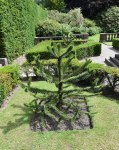
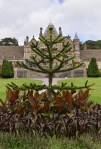
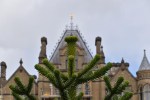
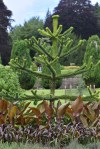
At the National Trust’s Biddulph Grange garden in England they have a little terraced gardens in the section called ‘Italy’ which has four small monkey puzzle trees in a little box-edged parterre centred on a stone vase (Figs 1–3). This is called the Araucaria Parterre after the botanical name of the plant (Araucaria araucana).

It is one of the most characteristic Victoria specimen trees, identifiably Victorian in that cultivation in Britain was begun only in the 1840s, but out of favour since.  The reaction set in quickly: Thomas Mawson as early as 1900 wrote that ‘Araucaria imbricata, or monkey-puzzler, is a variety most unsuitable for garden planting; its proper place is in an arboricultural museum, or piece of ground devoted to freaks of nature.’ (Thomas Mawson, The Art and Craft of Garden Making, 2008 facsimile reprint of (I think, 1900 edition), p. 133.)

It is indigeneous to Chile, was first noticed by Europeans in the 1780s, and was brought to the notice of the British by Archibald Menzies, the surgeon on the Discovery, Captain Cook’s former ship, then circumnavigating the globe under Captain George Vancouver. He was offered the seeds at dessert at a dinner with the Governor of Chile, and pocketed some. He raised five seedlings on shipboard,on his return giving one of them to Sir Joseph Banks  who planted it at Kew Gardens where it lived for 100 years. (The name araucaria araucana derives from the Conquistador name of the native Chileans (actually Maupeche) who used to eat the nuts.) They were properly introduced into Britain only after 1842, when William Lobb, who worked for Veitch nurseries in Cornwall, was send to Chile to collect the seeds. The name ‘monkey puzzle’ was coined by Charles Austin who, when shown a specimen in Cornwall in about 1850, remarked that ‘It would puzzle a monkey to climb that’. The Australian Bunya pine is a close relative, evolving a little differently after Gonwanaland split up. Monkey puzzles are endangered in Chile after bushfires destroyed much of the remaining forest.

The Araucaria Parterre at Biddulph Grange was one of the first parts of the garden created by the botanical enthusiast James Bateman after he bought the property in 1840, so he was an early adopter. They grow to very big trees, and so when they got too big he would transplant them to his arboretum, a practice that is continued by the National Trust.

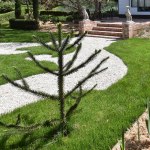
The reason why I find this story so fascinating is that not only does Villa Castagna have a large monkey puzzle tree, probably somewhere between 130 and 160 years old, but Montacute has an ‘Araucaria Parterre’. This is the Parterre à l’Angloise, which has monkey puzzles planted separately on either side (Fig. 4). I had not heard of  the Biddulph Grange parterre when these were planted, but it is nice to have an unusual garden idea validated in this way. The two trees are seedlings of the big one. They were already planted there before the parterre was made, and the left-hand one was incorporated into the design, and the right hand one was moved to match.

It appeared to me to be a rather radical idea to use monkey puzzles in this way, both because they are rather spiky and because eventually grow large. Biddulph Grange has validated this ‘arboricultural insanity’,[1] as well as showing how to resolve the size problem. Fortunately they are very slow growing, so it will be someone else’s problem to transplant them into an arboretum when the time comes!

These seedlings were self-sown from the big monkey puzzle in a poorly maintained bed under the big tree. (Monkey puzzles do not produce seeds until they are 30 to 40 years old.) There were four; the other two were given away. Another seedling formed later is growing in a pot (Fig. 5). Monkey puzzle seedlings are tiny furry things, and the two in the parterre have taken good ten or fifteen years to grown to their present size. (The left hand tree developed a double trunk, one of which I cut off when the parterre was made; it now matches the other perfectly and you would not know it.)

The big monkey puzzle is basically female, but some years ago a man writing a book on monkey puzzles came around to look at it, and suggested that it might have been bisexual, and he handed me a male flower. But it is possible that this was brought here by a bird, as there are other monkey puzzle trees in the town.

Incidentally, the young monkey puzzle trees in the Wombat Hill Botanical Gardens are also children of the big monkey puzzle. When he retired a few years ago the curator told me that when he started there in 1983 (there was no curator before that) he came and took seeds from our tree to grow these. He assumed that someone else owned the property then, and I generously did not accuse him of trespassing! These trees are therefore now 34 years old, but they are still not very big – about 5 metres high I guess and about 150 mm in diameter (Fig. 6).

Monkey puzzles are said (on little apparent evidence) to live as long as 1000 years.[2] It likes ‘temperate climates with abundant rainfall’, which makes it marginal for Daylesford, and our tree suffered badly in the drought, dying back extensively on the south side.

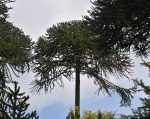
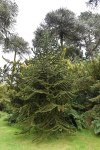
I now collect picture of monkey puzzle trees on my travels. Biddulph Grange has many mature examples. These have few branches on the trunk and quite rounded canopies (Figs 7, 8). This growth habit is similar to Roman pines in the Villa Doria-Pamphili, where the lower branches are pruned off, so possibly the same has been done here. Some young specimens have luxuriant spreading branches lower down (Fig. 9). Ours show no such tendencies.

There is a good young specimens at Tyntesfield, also an important Victorian garden (Figs 10–12).

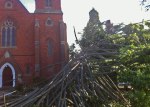
Daylesford once had an important bunya pine outside the Uniting Church. In a storm on 1 March 2015 it simply snapped in two (Figs 13–15). This could only have happened if there was a violent twisting motion, like a tornado. Our monkey puzzle further up the hill was unaffected, although a street tree not far away was similarly twisted until it broke. The bunya pine was not replaced.

More Monkey Puzzles

This is a monkey puzzle growing in the cloister of the Franciscan church in Bolzano. It seems to be thriving in what looks like a shady spot in a cool alpine area.


[1] As Matthew Wilson, writing in the Financial Times (6 July 2013) put it: ‘One of the peculiarities of the monkey puzzle is how frequently, for what is after all a large forest tree …, it can be found in tiny front gardens. Either this is an example of a mass act of arboricultural insanity or, perhaps more likely, due to its popularity as a “spot plant” or focal point in formal bedding schemes where its form and curious, shiny foliage would have been much admired. Fast forward to today and … the once diminutive spot plant grown into a fully fledged tree ….

[2] http://conifers.org/ar/Araucaria.php

Posted in All Posts, Architecture, Arts and Crafts Movement, Baroque Gardens, Garden History, Montacute, Plants, Uncategorized, Villa Castagna, Wombat Hill Botanical Gardens | Tagged , , , , , | Leave a comment

Portmeirion 2. Portmeirion and the Picturesque

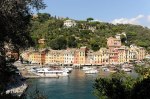
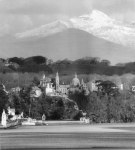
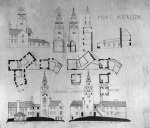
The most useful way of approaching Portmeirion is through the concept of the picturesque. Williams-Ellis (or, as everyone calls him, Clough) explains how he liked sailing around the Mediterranean and enjoyed the view of coastal towns from the sea. He strenuously denied, however, that Portmeirion was based on Portofino, and indeed the whole point about Portofino is that the buildings are down at water level (Fig. 1). He tried to buy an island but couldn’t find one and settled on an promontory, but one with a spectacular view of one of the finest tidal estuary in Wales, the Dwyrd Estuary, which was also not far from his home. But the fact is that the initial buildings are wholly picturesque, or, if you like, scenographic, in that they were designed as exteriors to be seen from the sea (but also from the land), and an early drawings is explicitly labelled so (Figs 2 and 3). The view from the other side of the estuary today (Fig. 4) shows how effectively the original group of buildings work in this way.

The interiors are an accidental by product of this design process. The best of the original buildings, such as the Campanile (Figs 5–7), is by definition devoid of an interior, while Clough stated explicitly that he built the domed building or Pantheon 1961-62 (Fig. 8), because he believed that every coastal town should have one, as many of those on the Ligurian coast do. The interior of this dome, however, is deeply uninteresting: it is like a domed version of a school shelter shed (for those old enough to remember when schoolyards had such things.)

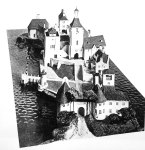
But this insight needs to be modified a little. What works better that the distant view in Fig. 4 is the aerial photo that is used on the cover of the book Portmeirion, by Jan Morris et. al (2006) (Fig. 9). This can be compared to a photograph of a model that Clough made before he bought the peninsula, that it represents the ideal that he was seeking (Fig. 10).[2] Both are necessarily seen from above, and both have an intriguing use of massing and variations in height and alignment, and a multiplicity of vertical accents. This model looks more German than Italian, but a German hill town: it is hard to think of anywhere in Europe that looks like this and is on the water. The gateway, with its double rounded bastions and curved tile roof looks incredibly German (Fig. 11), although Clough used such rounded forms in his other buildings are they are supposed to have roots in a local vernacular, although I can’t think of examples.

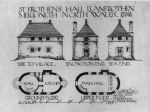
The gateway is built into another building with an open roofed tower space that in Italy would have been called an altana. From the gateway a path runs to the main ‘castle’, with a road at right angles leading to a jetty with a lighthouse. The main pathway leads to a tower with a passageway running through it, again very German. The roof follows a gentle curve, as found in his other building, with an oversized and unusually vertical lantern, proportioned similarly to the one on the domed building much later (Fig. 12). This over-scaling and over-verticalising of such a feature is therefore an expression of Clough’s taste. There are two more towers, a cluster of connecting buildings (some of which could almost be Scottish), all ending in a round-ended building similar in form with the gateway towers that might be read as a church were it not that Clough had no interest in religion (one of the things that makes him so likeable). (He resisted efforts to turn the domed building into a religious or quasi-religious building.) He was probably thinking of something like his design for St. Brothen’s Hall, Llanfrothen (1911) (Fig. 13).

He was not much interested in history either, as the lack of clear typological identity of the rest of these buildings makes clear. There is no hint architecturally that this was once a fortified castle or anything like that. The relative breadth of the towers suggest that he was already thinking of then as hotel rooms.

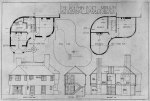
The perspective view on the preliminary plan drawn to attract financial backers (Figs 14, 15) shows how this was rethought with the new site in mind. Essentially it is a cluster of three interconnected building on a bastioned terrace set at a cliff edge. There is a broad tower with entrance passageway with a vernacular building with a skillion roof built up to it, connected on the other side to a conventional chimneyed building of eighteenth-century type on an angled plan.

By the time Clough came to start construction in 1928 the tower had changed function to become, not a German gateway tower, but an Italian Bell Tower, or Campanile (Figs 5–7) that is too small to have useful interiors. Clough wrote that ‘it was imperative that I should open my performance with a dramatic gesture of some sort.’ The need to create a striking architectural image that would proclaim the nature of the venture, like an architectural sign, a company logo, or indeed a three-dimensional equivalent of the prospectus drawing prevailed over the need for useful accommodation. The village is sometimes called Italianate, but this is the only building that is meaningfully so. Even then we have to be careful: the Serliana (as a Palladian window) is also an English Palladian motif, the volutes near the lantern are more Dutch in inflection than Italian (and characteristic of Clough), the concave lantern roof is un-Italian, leaving only the buttresses which could be as much Hawksmoor as Italian. This leaves the principal Italian element being the idea of a detatched campanile itself.

The cluster of buildings around the campanile are by far the most picturesque in the whole complex, but Clough’s initial conception also conceived a central piazza, really a village green, in pictorial terms. The preliminary plan designed with financial backers in mind (Figs 14, 16) shows a perspective of this area that distorts the expansive lawn and loggia building at the right as shown on the plan. This shows a cluster of buildings that manage to retain eighteenth-century forms a symmetries which being clustered together picturesquely, rather like Princes Charles’ Poundbury, which respond to Clough’s evident concern that to make a picturesque composition buildings need to be physically connected.

The actual Piazza was only created in the early 1960s where there had been a tennis-court and incorporates pre-existing buildings going back to the nineteenth century, such as The Mermaid (built c. 1840, dressed by Clough in 1926) (Fig. 17). Some buildings, such as The Angel (1926) (Figs 18–20), part of the early construction but a little separate from the Campanile group of buildings, display those rounded Arts and Crafts forms seen in the model, while the Town Hall (1937-38) (Figs 21, 22) plays with Jacobean because made from salvage, while other are Neo-Georgian or play with Dutch gables reflecting his later architectural taste. One supposes that the later buildings (apart from the domed building) were designed with the view from the ground in a gradual process of infilling, when the picturesque impulse was waning.

Posted in All Posts, Architecture, Art, Arts and Crafts Movement, English Gardens, Fabriques, Garden History, Town and Village, Uncategorized | Tagged , , , , , , , | Leave a comment

Portmeirion 1. Introduction

People don’t always get Portmeirion (Fig. 1). For example, it has been argued that it is a proto-Post-Modernist work, created by an architect trying to subvert the modernist norm long before Venturi and Scott-Brown came on the scene. But this is all wrong. Clough Williams-Ellis belonged to the dominant architectural tradition of his generation, a version of Arts-and-Crafts, moving on to Neo-Georgian and a bit of 1930s modernism. He was a successful country-house architect, he helped to saved Stowe, he participated in the 1930s reaction to the horrors of the rapid speculative suburbanisation of London, and he contributed designs to the New Towns movement in the 1950s. He admired Lutyens, but his tastes were alien in many ways to the Old English/Jacobethan interests of the Arts and Crafts architects of the generation prior: old photos of his family house near Portmeirion, called Plas Brondanw, show it filled with Georgian furniture, the kind of furniture we (since then) have learned to call ‘antique’. This is at odds both with contemporary taste and with the furniture tastes of the Lutyens generation, which was all oak and gate-leg tables. His architectural tastes were conservative and backward looking (although his politics was more radical) but he was not reactive (except in urbanistic matters), certainly not against modernism which had not yet established itself. Indeed he gives an admiring dscription at length of the Festival Hall, created for the Festival of Britain in 1951, and about the only building of note under construction in Britain in those years.

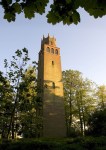
Portmeirion is also called a folly, even the last folly ever made (not so!). One expects a folly to have been built by a rich and idle aristocrat with nothing better to do with his money in order to demonstrate his aristocratic disdain for practicality. The tower built by Lord Berners at Faringdon Hall in 1935 better fits this description (Fig. 2). The difference between aristocrats (and their contemporary equivalent, the mega-rich who have inherited or married their wealth) and the middle classes is that aristocrats derive their identity from who they are, while the middle classes derive their identity from their work. In this respect Clough Williams-Ellis was undoubtedly middle-class. Portmeirion was never a folly: rather, it was the field for architectural invention of a professional architect who wanted to express an aspect of his imagination that did not find full expression in his professional work. And it was his own.

I have long been intrigued by the question of how much money he had. On the one hand he writes of how in the early pre-War period whenever he earned a little money from his profession he would spend it on walls at his family house near Portmeirion called Plas Brondanw. On the other had, he was a member of the landed gentry, and presumably inherited estates as well as the family house. He liked sailing around the Mediterranean in a yacht, not a cheap hobby, and he could afford to buy a whole peninsula in Wales for Portmeirion, even if it was a bargain. He could also afford to buy part of Stowe when it came on the market in the 1920s, although with the intent to saving it from developers, which he did, so that his ownership was only temporary. People of his class and generation were very good at keeping their capital assets and income distinct, and trading land and property were then not so valuable as income producers as they are now. Probably he had enough to live on without his profession, but not in much style, and his professional income was a significant part of his gross income. An early drawing for Portmeirion was drawn to attract interest from investors, but it seems that he seems to have spent his own money on Portmeirion in dribs and drabs, mostly between 1925 and 1939, and from 1954 (when wartime restrictions ended) and 1976 (he died in 1978). Late in life he observed of Portmeirion that ‘its economic success has staggered me’, so it seems likely that the later phase of construction was financed by Portmeirion as a hotel and tourism business at a time when his professional career had wound down.

Posted in All Posts, Architecture, Art, Arts and Crafts Movement, Baroque Gardens, Elizabethan Architecture, English Gardens, Fabriques, Garden History, Town and Village, Uncategorized | Tagged , , , , , , , | Leave a comment

Goddard’s in York: An Arts and Crafts House Made with Chocolate

Goddard’s is an interesting house and garden in the suburbs of York (Fig. 1). It was designed by Walter Brierly, the Lutyens of York, and has many Lutyenesque moments. (It is not to be confused with Lutyens’ building with the same name.) It was made for the Terry chocolate family, whose factory, now being converted to housing, is visible nearby. The Terry who built it, and who only died in the 1980s, in the same year as his wife, collected Georgian furniture which was willed to Fairfax House in the city centre, where it allows that building to be presented as an authentic seventeenth-century York townhouse.

The Trust only acquired Goddards for their offices in York, and only recently have opened half the house. The furnishings are consequently minimal. It is therefore rather a strange house in that it is an Arts-and-Crafts house the ‘true’ furnishing of which should be Georgian. This makes it a problem for the Trust. At Coleton Fishacre the Trust could reconstruct the Art Deco furnishings as recorded in photos, but here neither this strategy, nor an attempt to find Arts-and-Crafts era furniture, would be appropriate and to attempt to recreate the Georgian furnishings of its heyday would be bizarre given that the original furnishings are still visible a few kilometres way. As the main function of the building seems in reality to be a tea-room in the suburbs for local York people, I rather favour the idea of giving the interiors (including the living rooms) to a decorator to come up with a slightly theatrical neo-Arts-and-Crafts interior where it would be fun to have afternoon tea.

Most of the oak woodwork is in good shape, often Georgian rather than Elizabethan, which is understandable given Terry’s interests. The neo Georgian doorcase under the staircase leading to the tea-room on the ground floor is rather good (Fig. 2). The tea room is fully panelled with a seventeenth-century century English style chimney piece all painted blue green, which made this more like Fairfax House (Fig. 3). Seeing one building immediately after the other made me realise the extent to which the Georgian Fairfax House is all about the staircase, which is lit by a beautiful two storey Palladian window (Fig. 4). The window necessarily does not follow the flights, but starts at the full-width landing. There is a servant’s staircase only a few metres away, which emphasises the way the functioning of the building depended on servants, and the social segregation.

At Goddard’s, on the other hand, the staircase, in a full-blown Elizabethan revival style (Fig. 5), though interesting, is not the main theme. It has a version of those ‘flat’ balusters that you find in many Arts-and-Crafts houses, the most authentic models for which see to be at Canons Ashby (Fig. 6). The oak carving of the details is good quality neo-Elizabethan (Figs 7, 8, 9). It leads to the galleries on both floors on the side facing the car entrance (Figs 10, 11). On the first floor a slightly raised alcove with gothic window bay over the porch is called The Bower (Fig. 12).

The gallery leads to a double living room (Fig. 13). This is painted a horrible shiny yellowed white paint. The light fittings seem to be original but the bracket lights are rather ugly. This has a half-width fireplace that is bigger and more expansive than an inglenook. The main space has a gateleg table of sixteenth or seventeenth-century type, a bit like the one shown in photos of the original furnishing (Fig. 14), with views onto the garden and a little nook where a party was having tea. The panelling give a more eighteenth-century air: it is interesting how by the 1930s things are blurring into an ‘early modern’ style, fusing everything from Elizabethan to Georgian. The fierce Old English nationalism of the later nineteenth-century has faded to a genteel aristocratic air, rather like the showrooms of a fashion house (or the gallery dressing of the Dior exhibition at the NGV, which prompted this analogy.) In short, the house was furnished with ‘antiques’, today a style that seems wholly dated. The old photo shows the rather horrible shiny paint was always there.

The niches in the living room (Fig. 15) demonstrate a desire to embrace the seventeenth century, and are interesting because they are made of wood. Niches are essentially a form that evolved from working stone, and the heads are difficult to execute in other materials. Brick niches, like those at the Oratory of the Filippini or the garden piers at Hampton Court, are tours-de-force of cut brickwork, and very expensive. Niches are practically impossible to do in wood. The heads here (Fig. 16) seem to be of solid carved wood. The cylinder seems to be of veneer or plywood. The shelves, designed to support ceramics, though, are of shaped wood supported on fretwork brackets, which is an interesting response in the material of wood to the niche form (Fig. 17).

Goddard’s is a much bigger building than it seems, since you are only allowed to visit half. There are copies of the original plans around the walls. It was a pouring wet day where the rain never let up and it was very cold. The only visitors apart from me seem to have been locals: a few local tourists and several who had come for the tea rooms.


Posted in All Posts, Architecture, Arts and Crafts Movement, English Gardens, Uncategorized | Leave a comment

On Water-spouts. Chastleton House

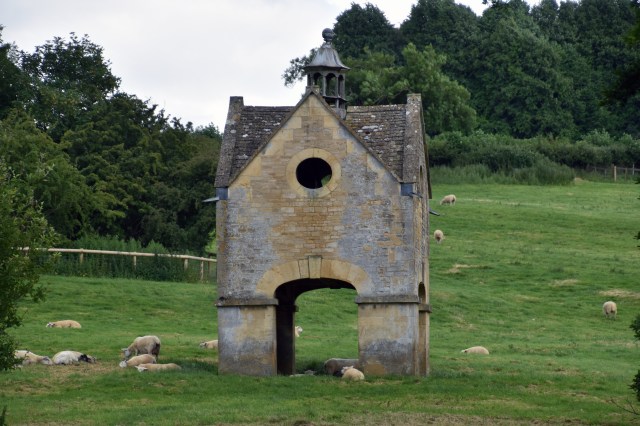
At Chastleton House there is a dovecote in the field over the road that is all that remains of another house there (Fig. 1).

Fig_01_0891

Fig. 1. Dovecote near Chastleton House.

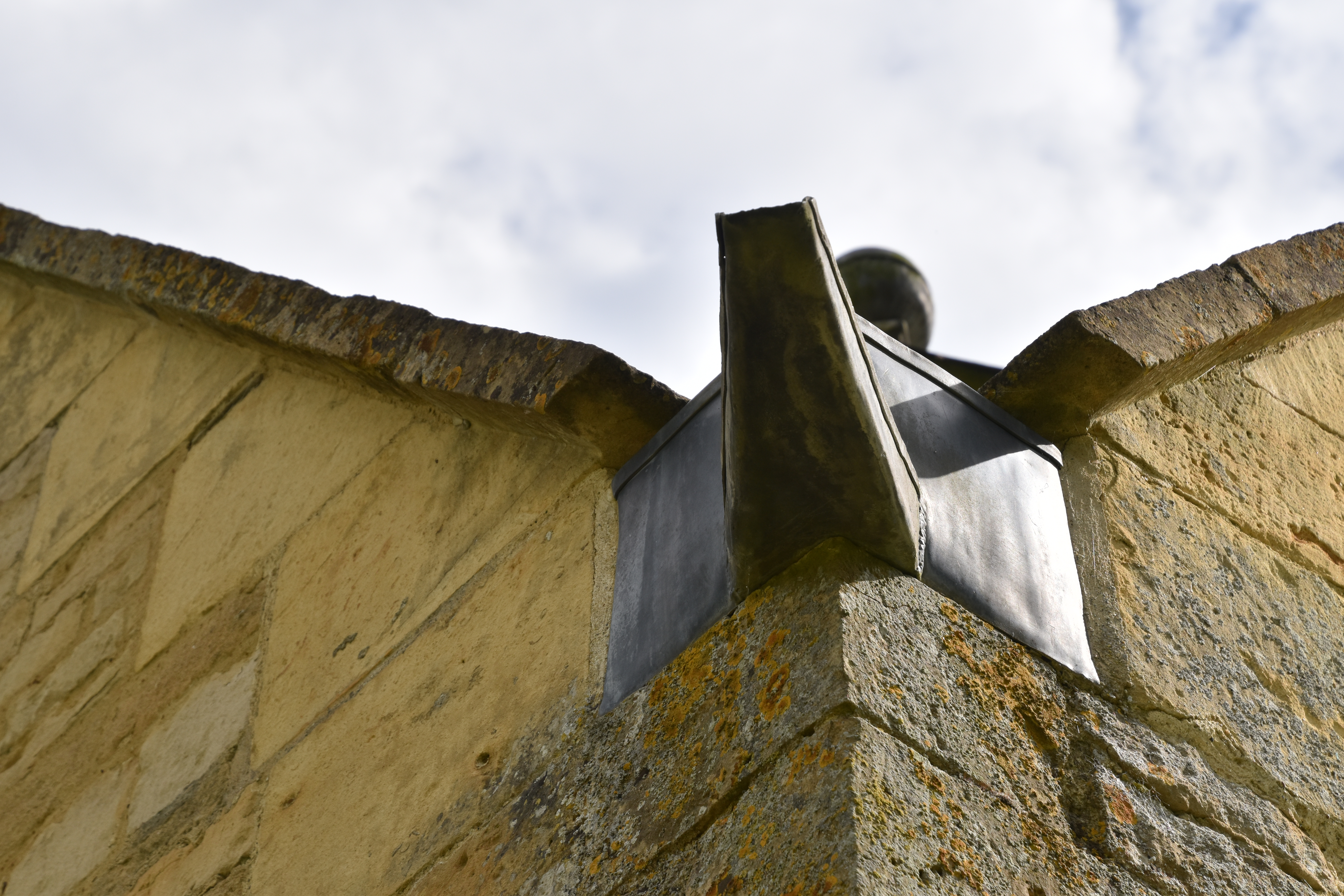
It dates from 1762. It is square in plan, with four arches on the ground floor under which sheep now shelter, and an upper storey with round openings on each side and a roof deriving from a gable on each side. At the corners, clearly part of the design, are waterspouts of channel type (Figs 2–3).

Fig_02_0906

Water spout of dovecote near Chastleton House.

Fig_04_0913

Water spout of dovecote near Chastleton House.


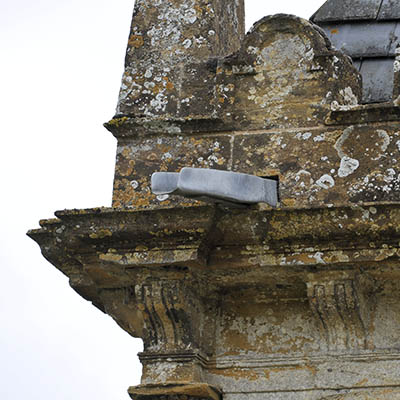
There are similar spouts on the Montacute pavilion, but they look like later additions that have been cut into the guttering. (Fig. 4). The waterspouts on this dovecote are clearly part of the original design, even if they have been renewed, so perhaps the Montacute spouts were originally here.

Water spouts, pavilion at Montacute House, Somerset.


Posted in All Posts, Architecture, Arts and Crafts Movement, Elizabethan Architecture, Fabriques, Montacute, Uncategorized, Villa Castagna | Leave a comment

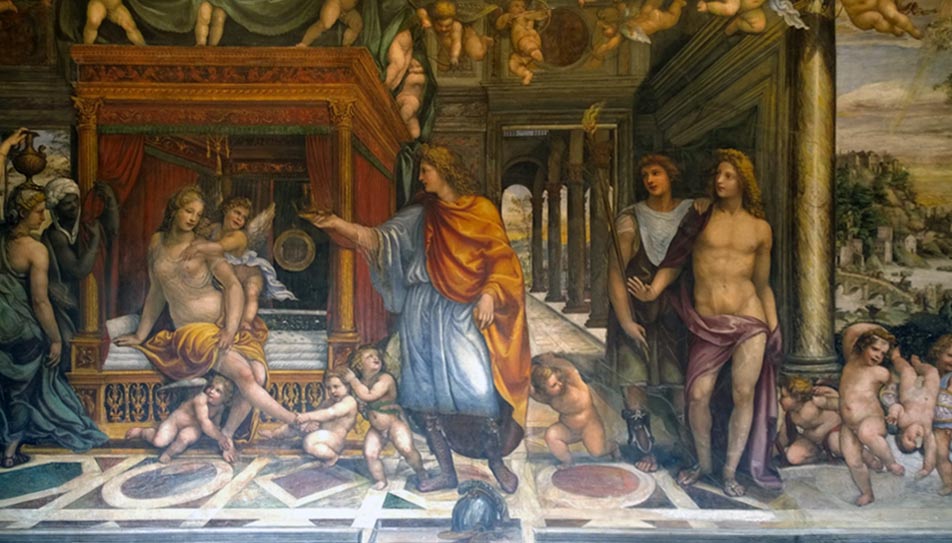
The Bed in the Marriage of Alexander and Roxane in the Villa Farnesina (1517)


This fresco is ground upstairs in the Villa Farnesina, Rome. The Villa Farnesina was the villa of Agostino Chigi, the banker to Julius II and the richest man in Rome. His first wife had died childless and his mistress, a Venetian woman, Francesca Ordeaschi, bore him five children. The pope leaned on Chigi to legitimise their relationship, which he did, making his sons his heirs. Much of the decoration celebrates his love of Francesca and their forthcoming wedding, including Raphael’s Loggia di Psyche on the ground floor. He died in 1520 and she died seventh months later, either from poisoning or suicide. A liebestod is considered to be more romantic. The fresco, by Sodoma, following a design by Raphael, shows an elaborate carved wooden bed in the antique manner, with carved columns, cornices, fabric valances and expensive red curtains.

Alexander the Great married the daughter of a Bactrian princess in 327 B.C. The roman writer Lucian created an ekphrasis about this event. (An exphrasis is a poem purporting to be a description of a painting.) Ekphrases were of particular interest to Renaissance painters, who had seen no monumental antique paintings, and some of the greatest Renaissance paintings, like this one, were reverse ekphrases — attempts to recreate what the painting in the poem would have been like.

Sodoma (and Raphael) followed Lucian’s ekphrasis closely:

[Lucian, 7.1] The picture is in Italy; I have seen it myself and can describe it to you. The scene is a very beautiful chamber, and in it there is a bridal couch with Roxane, a very lovely maiden, sitting upon it, her eyes cast down in modesty, for Alexander is standing there. There are smiling Cupids: one is standing behind her removing the veil from her head and showing Roxane to her husband; another like a true servant is taking the sandal off her foot, already preparing her for bed; a third Cupid has hold of Alexander’s cloak and is pulling him with all his might towards Roxane. The king himself is holding out a garland to the maiden and their best man and helper, Hephaestion [the clothed man at the right], is there with a blazing torch in his hand, leaning on a very handsome youth I think he is Hymenaeus (his name is not inscribed) [i.e. Hymen, the god of marriage].

[7.2] On the other side of the picture are more Cupids playing among Alexander’s armor; two of them are carrying his spear, pretending to be laborers burdened under a beam; two others are dragging a third, their king no doubt, on the shield, holding it by the handgrips; another has gone inside the corslet, which is lying breast-up on the ground—he seems to be lying in ambush to frighten the others when they drag the shield past him.

[7.3] All this is not needless triviality and a waste of labor. Aetion is calling attention to Alexander’s other love – War – implying that in his love of Roxane he did not forget his armour.

Sodoma plays down the militaristic theme of the last paragraph, as being inappropriate to Agostino Chigi.

In a convex mirror within the bed can be seen another bed, this time fully covered with black draperies, implying a bed behind the viewer. In the inventory made at his death the room of Alexander was listed as Francesca’s bedroom, and there are payments for two elaborate beds with black and red draperies and expensive inlays.

The painter, then, is clearly making a connection, not only between the coy Roxane and Francesca Ordeaschi and between the love-struck Alexander and Agostino Chigi, but also being the marriage bed of the greatest general of antiquity and the real bed in this room.

Where would the bed have gone? Mostly beds in palaces went on one of the two side walls. The right side wall has a fireplace, but the left side wall has a comical fresco of Alexander on his horse Bucephalus, which was added later, and this is where the bed would have been. Seated in this bed, the couple would have looked left out of the bed to the parallel illusionistic world of the bedroom of Alexander and Roxane.

Posted in All Posts, Architecture, Art, Design, Rome, Uncategorized, Villas | Leave a comment

On Garden Gateways: Part 1. Serlio’s Libro Estraordinario

Sebastiano Serlio’s Libro Estraordinario (Lyons, 1551, also 1558 and 1560) contrasts thirty rustic gateways with twenty ‘delicate’ ones. In a well-known passage, Serlio describes how he came to conceive them:

‘… finding myself continually in this solitude of Fontainebleau, where there are more beasts than there are men, and having brought a long task of mine to conclusion, the desire came into my mind to form in a visible design several gateways in the Rustic style, but which were mixed with different Orders, that is, Tuscan, Doric, Ionic, Corinthian and Composite. And this was not without reason, because many times I saw and heard people looking at and praising the gateway of the Very Reverend and Exceedingly Illustrious Cardinal of Ferrara [of the Hotel du Grande Ferrare; the gate still stands, Fig. 1.] … and many wanted a copy of it so as to make use of it for themselves. From this sprang the idea (as I said above) of beginning such a task. [The first design is the portal of the Grande Ferrare, Fig. 2] And I advanced so far as to make a total of XXX, almost carried away by an architectural frenzy [furore architettonico]. Nor was this sufficient—sensing as I did that my mind abounded in new fantasies—hence I decided to make up XX of delicate work, also of different Orders, so as to satisfy the many desires of men and for the common benefit of this fine Kingdom of France (which has so great an interest in architecture) but also for the benefit of all inhabited countries …’

In a rather curious analogy, John Onians observes that:

‘Just as the Pantheon makes ugly people look beautiful for the short time they are in it, the environment of Fontainebleau makes Serlio have a fit of “furore architettonico” until he gets rid of it by exhausting himself in a bout of creativity’.[1]

The process described by Serlio is one of the great statements of artistic inspiration as a non-rational process, driven by an uncontrollable creative urge. In antiquity this was largely confined to poets, who would be possessed of the furor poeticus, which came from the gods, especially Apollo, the Muses and Orpheus. It came easily to musicians as well as poets (in antiquity they were the same thing), as in the anecdote about Mozart folding and refolding his napkin in ever more complicated patterns as new musical ideas flowed through his head.

The physical labour involved in most visual art production—apart from napkin folding—tended to deny such inspiration to artists, but drawing could be almost as responsive to fleeting creative ideas as speech. Leonardo da Vinci was perhaps the first pictorial artist capable of a creative frenzy through drawing, especially with the rapid pen sketch of a pictorial idea, the primo pensiero (Fig. 3).[2] Serlio was evidently heir to this, and the actual creative frenzy would perhaps have been first expressed in rapidly executed sketches. Or would it? Could he have maintained his initial creative frenzy in drawings almost as finished as the woodcuts and engravings made from them? There is a manuscript in Augsburg of these designs, probably pre-dating the final engraved designs, but these are finished drawings, and not the first idea.[3] But would the initial ideas have developed on the drawing board with ruler, or freehand in a sketchbook? Certainly when Domenichino came to play around with sketches for a church façade, he used the painter’s primo pensiero technique (Fig. 4). But would Serlio have done so?

This is indeed architecture as music. Within the strict results of the gateway form, and a relatively limited vocabulary of forms, Serlio could play numerous variations on the garden portal theme.

The first thirty designs (Fig. 5 shows one of the best, no. XXIX) were followed by twenty ‘delicate’ gateways (Fig. 6). Onians discerns an opposition here between the first thirty, which are ‘extravagant irrational designs’ while ‘the delicate ones are relatively rational and correct’.[4] He also develops the point that for Serlio the underlying rationality of the bizarre designs could be revealed by removing the rustication, so that it was like a civilised city gentleman adopting rustic trappings when going to the country without actually being a rustic.[5]

It is interesting that these are oppositions between two sets of designs. Serlio makes no attempt to show the front and back of the same gateway. This is true of most garden gateways, which tend to be of little interest on the inside: they are always oriented to the street. Even a garden gate in an expressive Serlian manner, like the grotesque gate to the walled garden at Castle Howard by Vanbrugh (Fig. 7), focuses on the outward face; the interior face has little to say (Fig. 8).

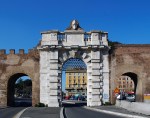
Town gates, by contrast traditionally have two faces, one for the wild outlands, the other for the civilized city within. This goes back to the Emperor Trajan, who ‘presented a rough Tuscan portal to the barbarians outside the frontier and a soft Corinthian portal to the citizens inside in an expression of his different attitudes to the different populations.’[6] Giacomo del Duca’s Porta S. Giovanni presented a nondescript face to the city (Fig. 9) but an aggressively rusticated one to the countryside (Fig. 10). But it was rarely always that simple, and the scenographic view from the city side prevailed in two important instances. Michelangelo’s Porta Pia presented a scenographic structure visible for miles down the Porta Pia (Fig. 11), but the exterior was unfinished and nondescript (Fig. 12). The sixteenth-century country façade of the Porta del Popolo was a highly civilised ‘porta delicata’ and dependent on the Orders (Fig. 13); while the interior (partly visible on the exterior) was another scenographic spectacle, this time by Bernini (Fig. 14).

Should a garden gate be likewise two-faced? A case can be made for it. The street face needs to be hostile and defensive, given the grim world outside of trucks and sticky-beaks cruising past in the 4WDs—modern versions of the wild beasts of Serlio’s Forest of Fontainebleau. The inside face could therefore be an assertive contrast: soft, erotic and romantic.

Such an approach competes with a Neoclassical conception of such a gateway, which would model itself on a Roman Triumphal arch like the Arch of Titus, which have two matching facades. Such a gateway is primarily an assertion of it its antiqueness. This is something to be avoided.

While many have borrowed from Serlio, a difficulty with Serlio’s furor architettonico is that its meaning lies largely in the multiplicity of the resulting inventions. The point of the Libro estraordinario, after all, is that it is a book. A single gate, by its nature, cannot express a furor architettonico, although it can be bizarre, delicate, or have some other such property.

It therefore makes sense to conceive of a garden gate as being like a town gate: speaking in both directions, to the hostile outer world, and to the intimate private world.

A garden face may be ‘delicate’, following Serlio, or relate more literally to the vegetation found within the garden—espaliered camellias and so forth—suggesting a model where such organic forms have a place, such as the Rococo or even Art Nouveau. The street face has more readily available models—almost all those discussed here—and demands to imitate rusticated stone, the primal expression of rustic defensiveness. Yet cursive forms need somehow to be made architectonic.

[1] Onians, 2006: John Onians, ‘Serlio and the History of Architecture, in Art, Culture and Nature. From Art History to World Art Studies, London, The Pindar Press, 2006, chapter XVII, pp. 358–376, see p. 372.

[2] Leonardo da Vinci, Study of the Madonna and Child with a Cat, c. 1478; Milan, Italy. Ink on paper, 19.9 x 28.1 cm. London, British Museum.

[3] Staats- Stadtbibliothek of Augsburg, 2.o Cod. 496. See Johannes Erichsen, ‘L’Extraordinario Libro di Architettura. Note su un manoscritto inedito’, in Christof Thoenes (ed.), Sebastiano Serlio: Sesto Seminario Internazionale di Storia dell’Architettura ; Vicenza, 31 agosto – 4 settembre 1987, Milan, Electa, 1989, pp. 190–195.

[4] Onians, Bearers of Meaning, p. 280.

[5] Onians, Bearers of Meaning, pp. 281–82.

[6] (Onians, 2006, p. 372, citing Serlio, Book vii, Staatsbibliothek, Munich, cod. Icon. 190, fols 19v and 20r.) Not sure if this is in the printed edition.

Posted in All Posts, Architecture, Art, Baroque Gardens, Design, English Gardens, Garden History, Uncategorized, Villas | Leave a comment

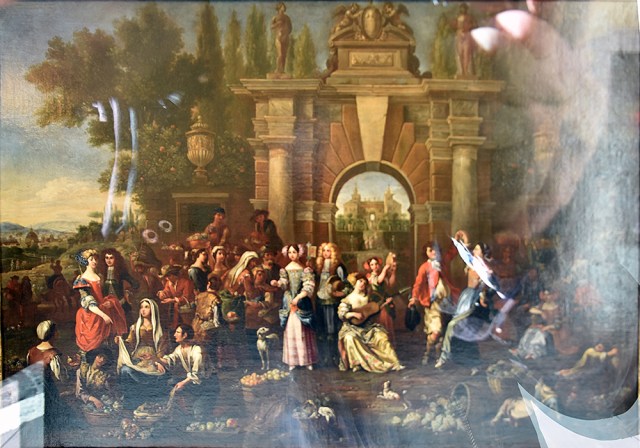
A Baroque Villa Garden in a Painting by Passeri

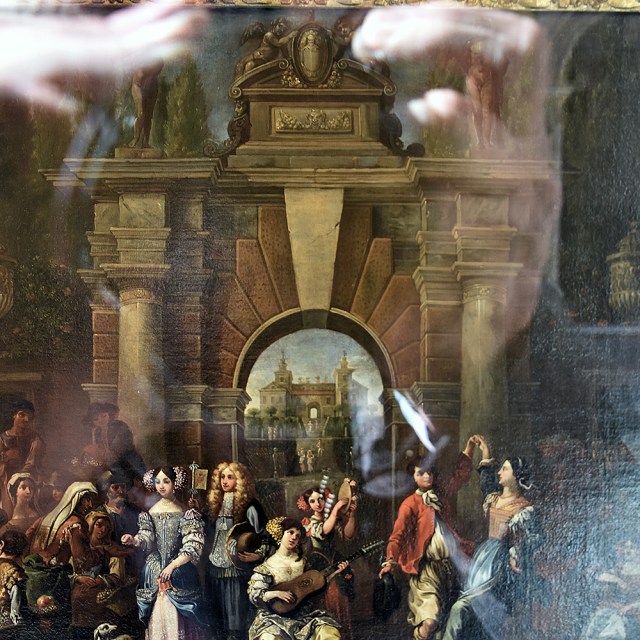
There is an interesting painting by G. B. Passeri in the window of Apolloni in Via del Babuino. It shows the ‘ottobrate’ (autumn festival) at a villa outside Rome, with a view of Rome in the distance. It shows two important components of a villa: the portal in the garden wall, ultimately derived from Serlio, and the main casino. It remains to be seen whether these are identifiable, or whether it is wholly imaginary. The casino has a passageway through the centre and two symmetrical wings, each with a tower. The passageway through the centre is suggestive. Most Roman villas were designed this way, but some, like the Villa Catena, Poli, began life as fortified buildings straddling a road, or indeed a crossroads. This situation can still be seen today at Isola Farnese. At Villa Catena they rerouted the road. In this case the ascent is steep, but your never know.

The lower terraces have wooden trellising with herms, the later like Villa Patrizi.

It would be worth looking for the model for the gateway.

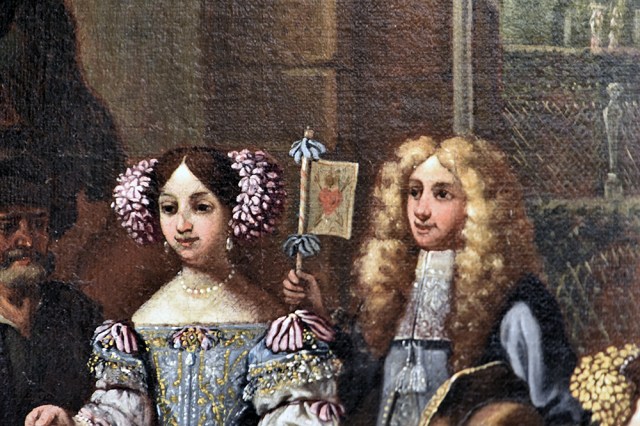
The noble couple at the centre are interesting. The woman gives alms, while the man holds an emblem with a heart crossed by arrows.

DSC_0185_DxO_adj_1000

DSC_0184_DxO_portal_1000DSC_0186_DxO_figures_1000

DSC_0182_DxO_adj_Whole_1000

Posted in All Posts, Architecture, Art, Baroque Gardens, Garden History, Uncategorized, Villas | Leave a comment