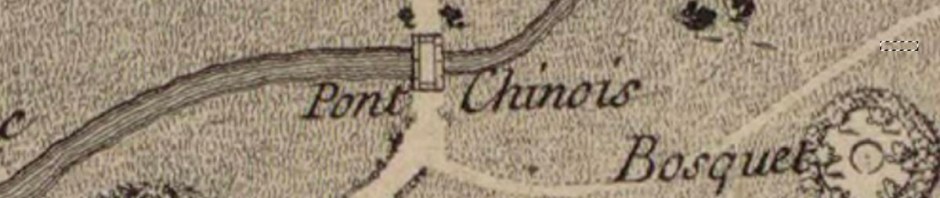
In the jardin Anglo-Chinois there is often a ‘Chinese’ bridge but there was no clear typology for such bridges. Whereas there were multiple images of actual Chinese pagodas, especially the Nanking Pagoda which was illustrated in the influential seventeenth century book by Neuhoff and which was the model for pagodas like the one by Chambers at Kew Gardens, there were few images of actual Chinese bridges. Yet the jardin Anglo-Chinois had a great need for bridges as it featured winding paths that criss-crossed streams, and some of these needed to be ‘Chinese’ in some way.
The Duke de Chartres’s Parc Monceau, designed by Louis Carrogis de Carmontelle (French, 1717 – 1806), known as Carmontelle, had a varied collection of fabriques, including Turkish and Tartar tents, a ‘circus, or naumachia’, a ruined ‘Temple of Mars’ and a Dutch windmill, sand these included a ‘Pont Chinois’. This we learn from the plan of the garden, the first of eighteen plates that comprehensively recorded its appearance in Carmontelle’s Jardin de Monceau, Paris, 1779 (English translation, 2020) (Figs 1, 2).[1] Strangely, though, the ‘Pont Chinois’, is nowhere illustrated, although it is referred to in the descriptions to the plates.
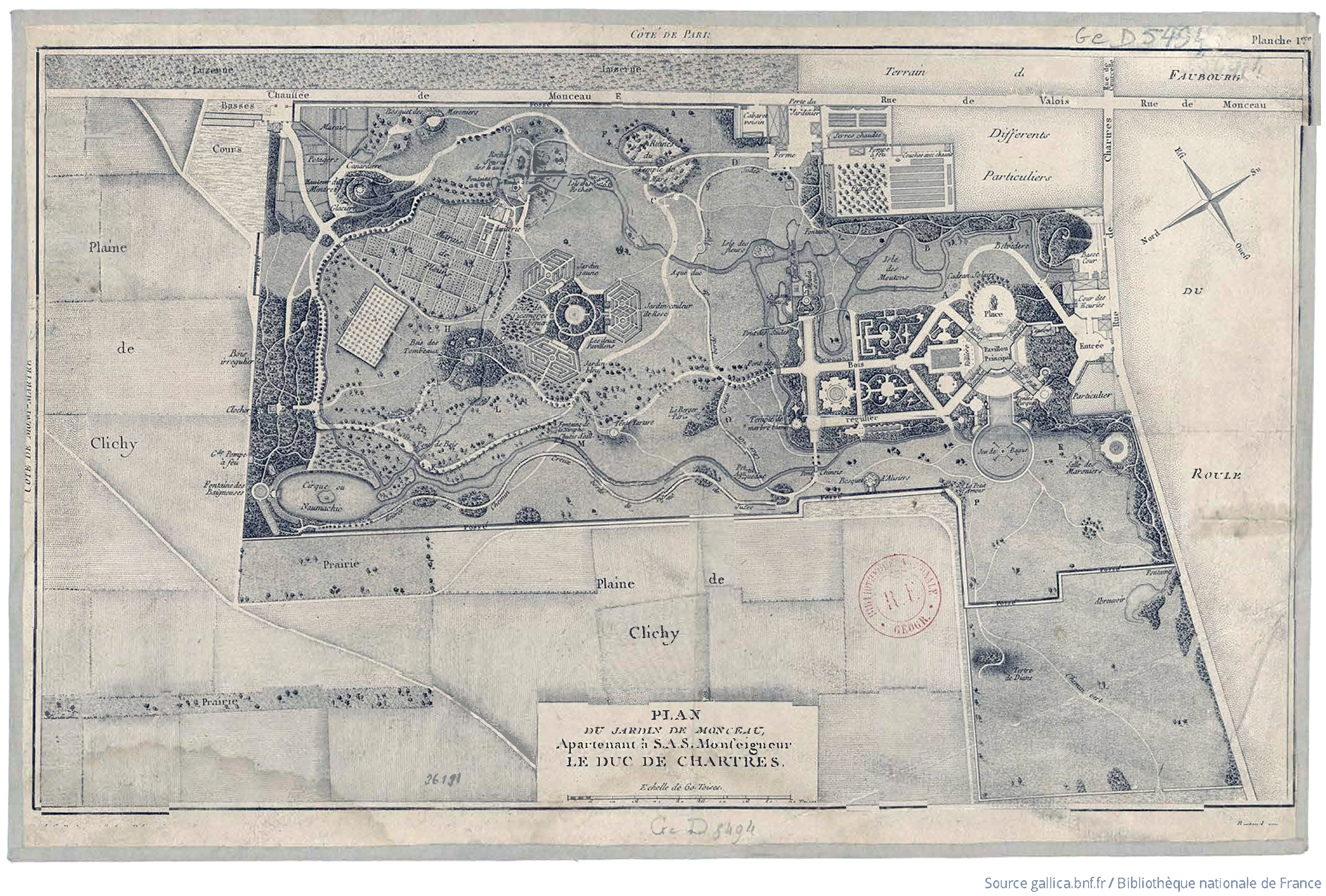
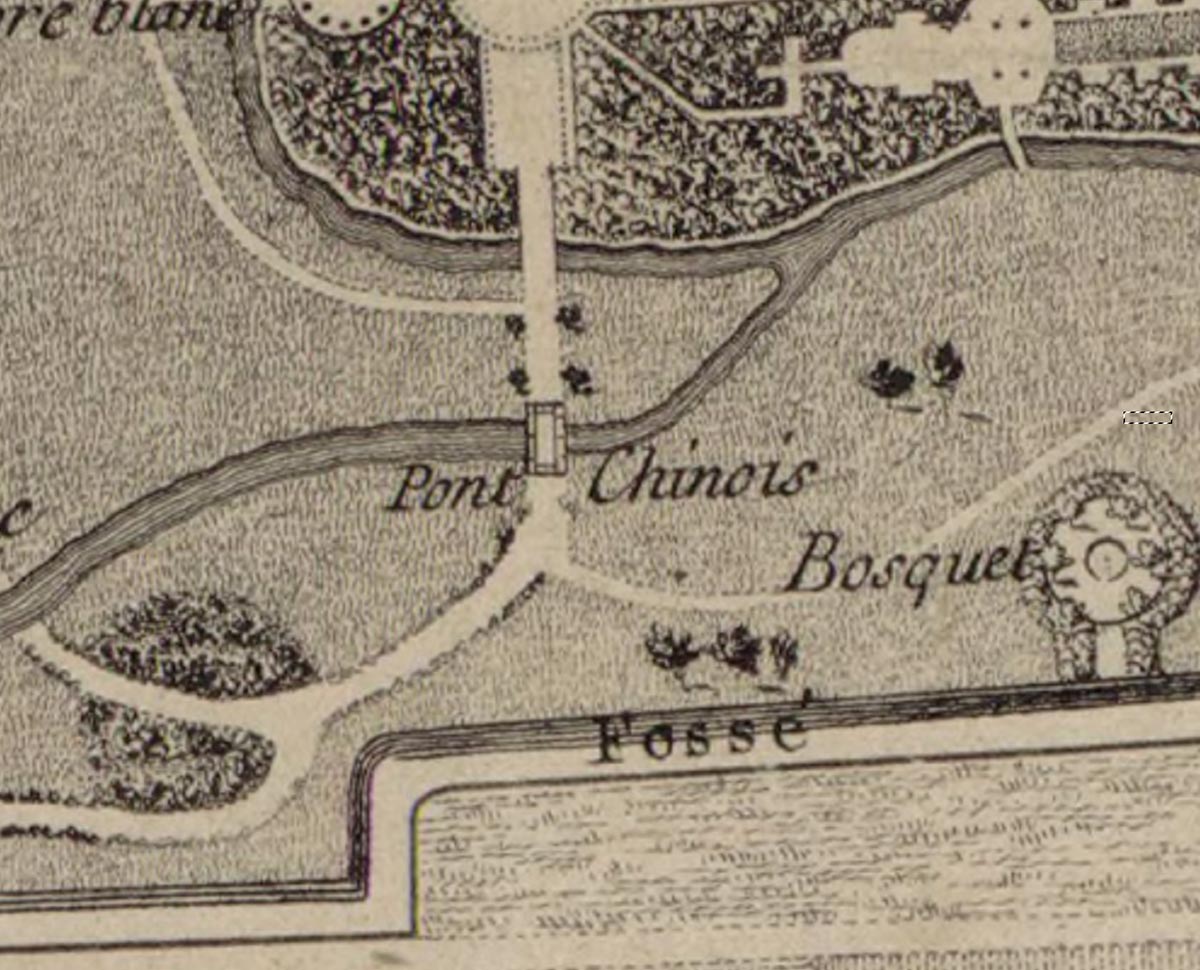
Carmontelle’s plan (Plate I) has letters marking reference points and viewpoints (Fig. 1). In Plate XIV, a view ‘Of the Tartar Tent, taken from point N’ (the text refers to ‘the sunken path along which one can walk in shade from the Chinese bridge [to the right] to the pool of the Circus [to the left]’, but the bridge is out of view (Fig. 3).
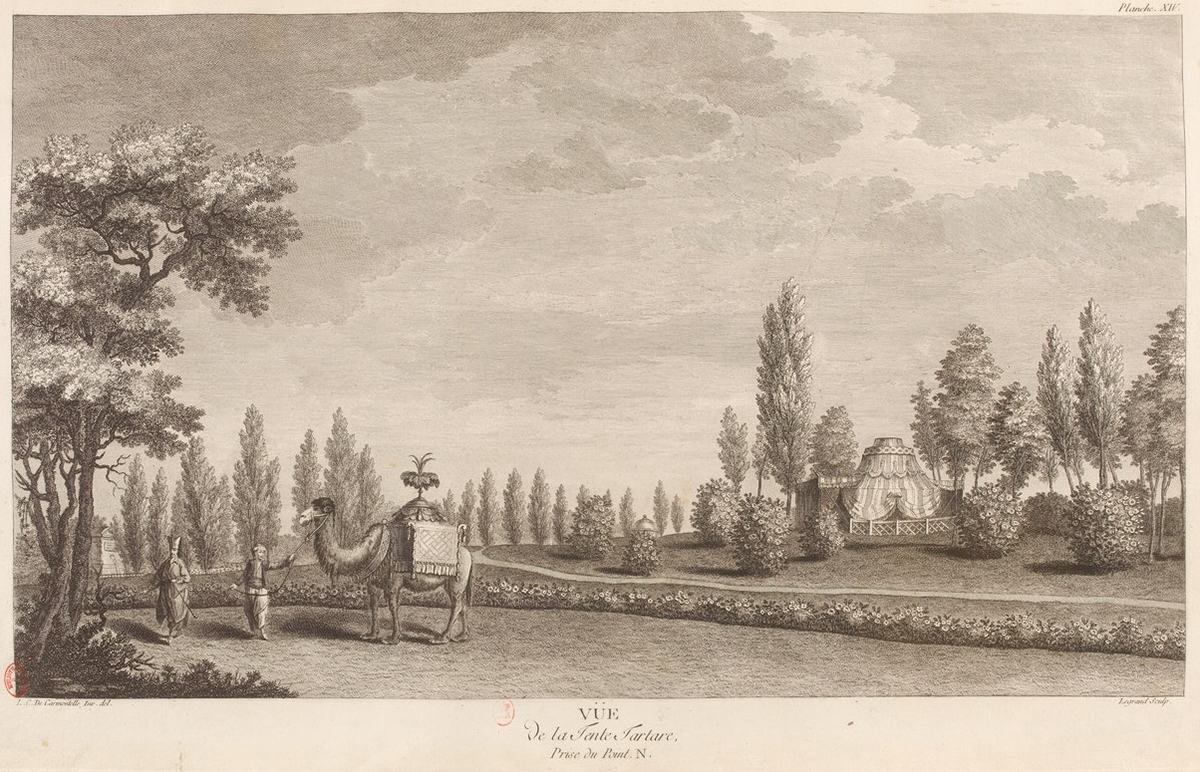
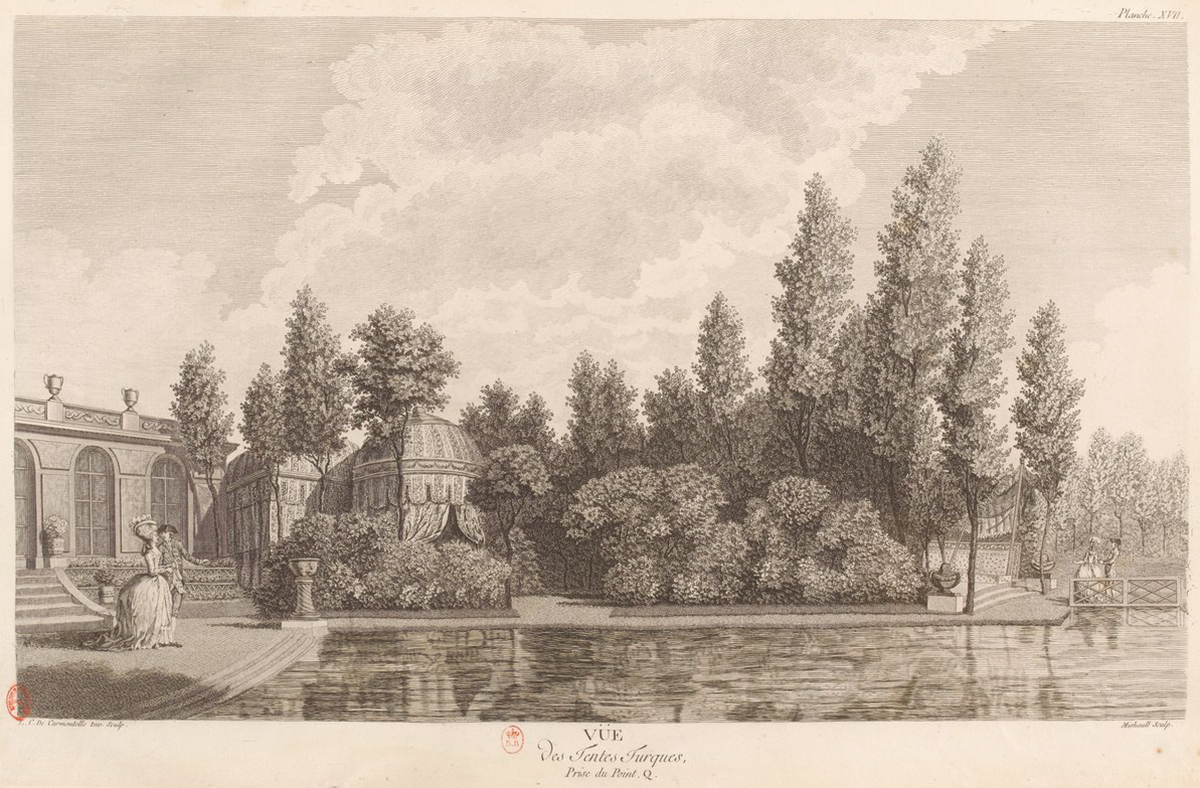
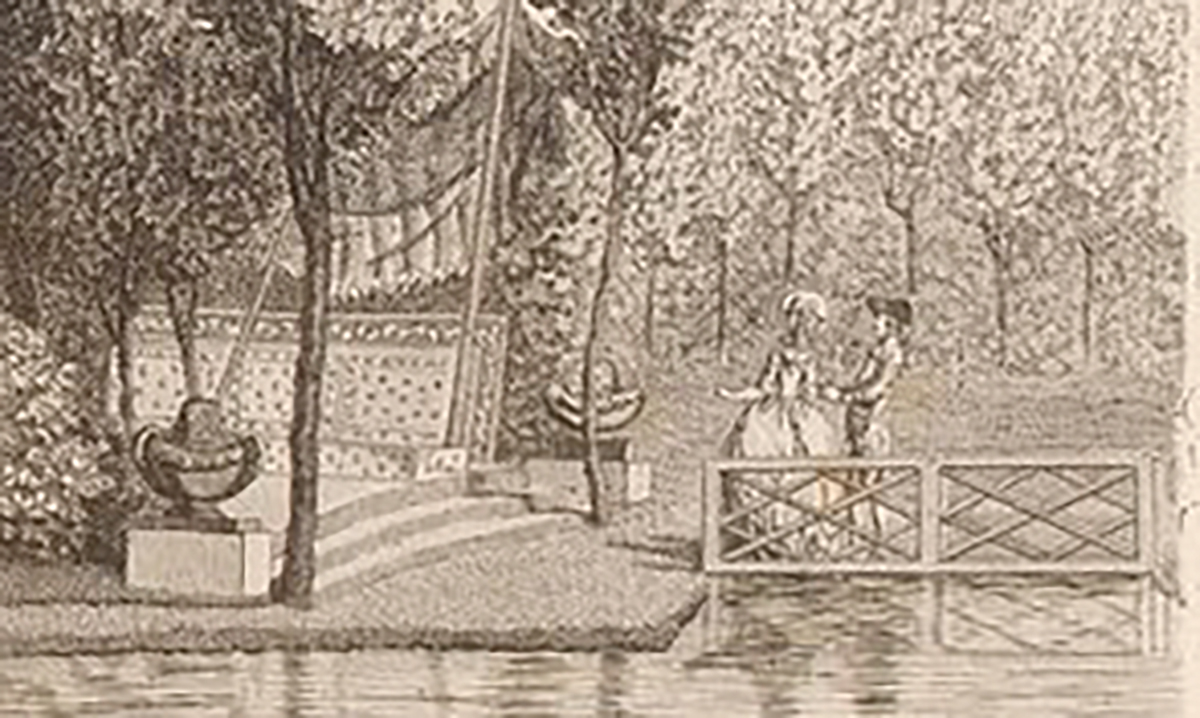
Plate XVII is a view ‘Of the Turkish Tents’ which are attached to the main pavilion at the right of the plan and are different from the ‘Tartar Tent’ (Fig. 4). The view is taken from point Q, which is near the head of the wide part of the pool which becomes a moat around the Jeu de Bague (Merry-Go-Round) island. It shows at the right one of two hemicycle seats, called ‘Ottomans’, which are ‘in stone & imitate Persian tiles’ with vases in red bronze with golden ornaments. In front of this is a little bridge with straight parapets consisting of two panel of criss-cross latticing (Fig. 5).
The corresponding bridge in front of the other hemicycle seat is depicted in Plate XVI, ‘Of the principal Pavilion & of the Carousel, taken from point P (Fig. 6)’. This seems to be made of two panels with diamond latticing, though there seems to be an extra section. The posts on the island are extended, and have dragons twined about them (Fig. 7). These do not appear in Plate XVII because the image ends on the right just at this point where they would appear.
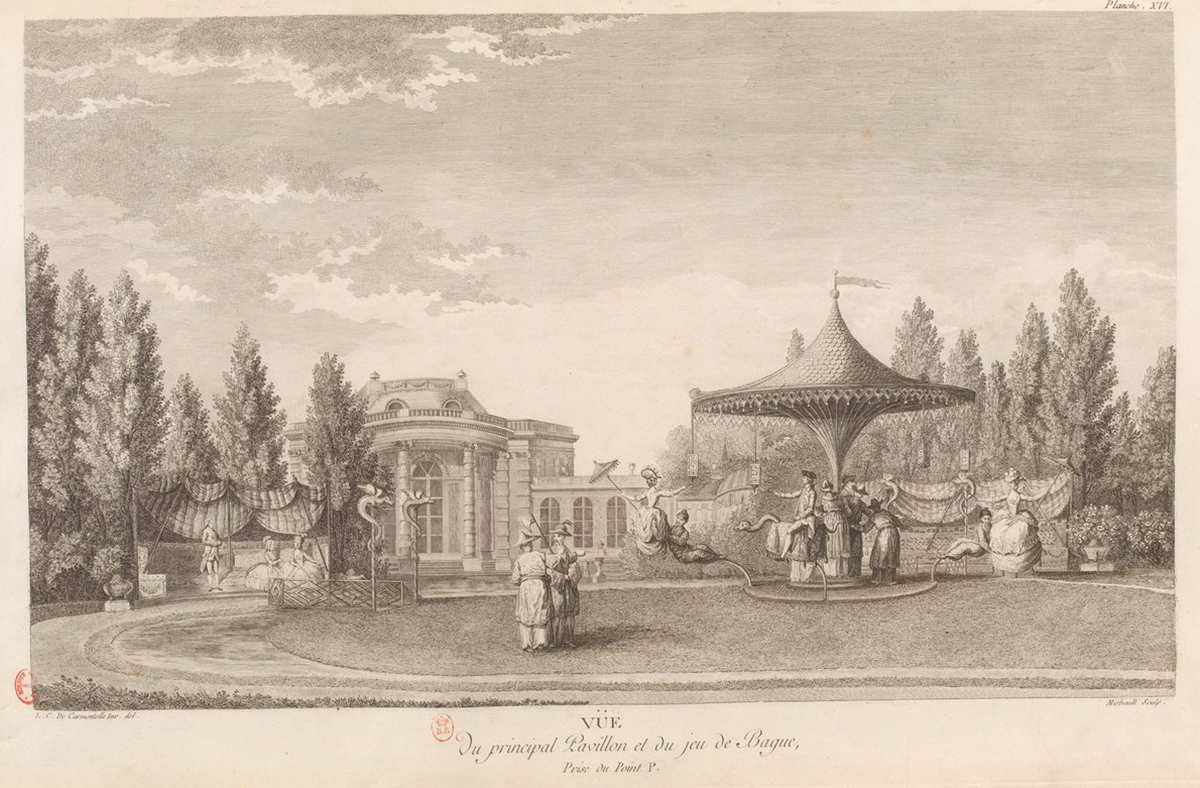
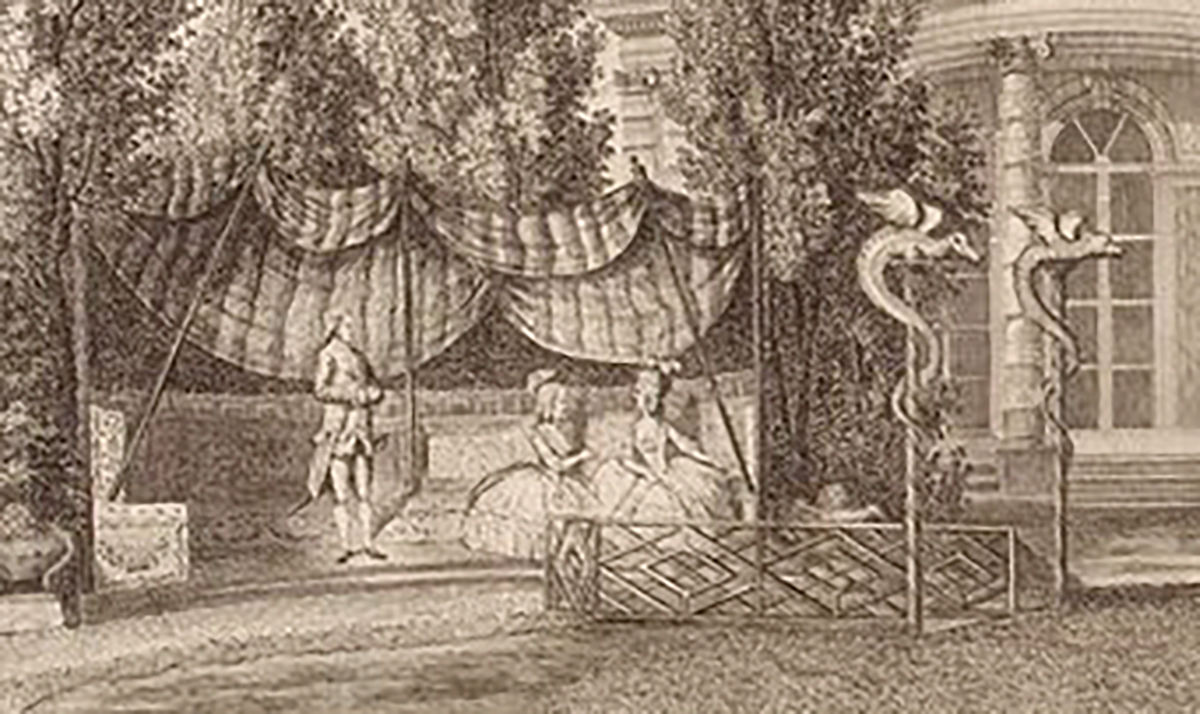
The text calls these bridges ‘Chinese’: ‘The Chinese bridges over which one passes to enter the Island carry on round to make balustrades in front of the benches, which are in the form of Ottomans’. I do not understand what is meant by ‘carry on round’ as no balustrades other than the bridge panels are visible. (These ‘Chinese bridges’ are not to be confused with the ‘Pont Chinois’.) Their Chineseness consists of the complex lattice work, the dragons, and the Orientalist flavour of this area (Turkish Tents, tiled ‘Ottomans’) which extends a pair of dragon seats for men and a pair of mandarin seats for women on the Jeu de Bague itself.
So what did the ‘Pont Chinois’ actually look like, and why did Carmontelle not draw attention to it by including it in one of his views? Perhaps it was too isolated from other features, and therefore did not lend itself to a pleasing pictorial composition. Yet it seems to have been rather more complex than the little flat bridges at the Jeu de Bague. A closer look at the plan has the ‘Pont Chinois’ drawn as two long rectangles, one within the other, joined by various short bars. What this represents is unclear: a central raised roof over a wider platform perhaps? The plan is more complex than the rendering of the ‘Pont de Bois’, which, appears on the map as a simple rectangle, yet the Pont du Bois appears twice in the views (Figs 8, 10).
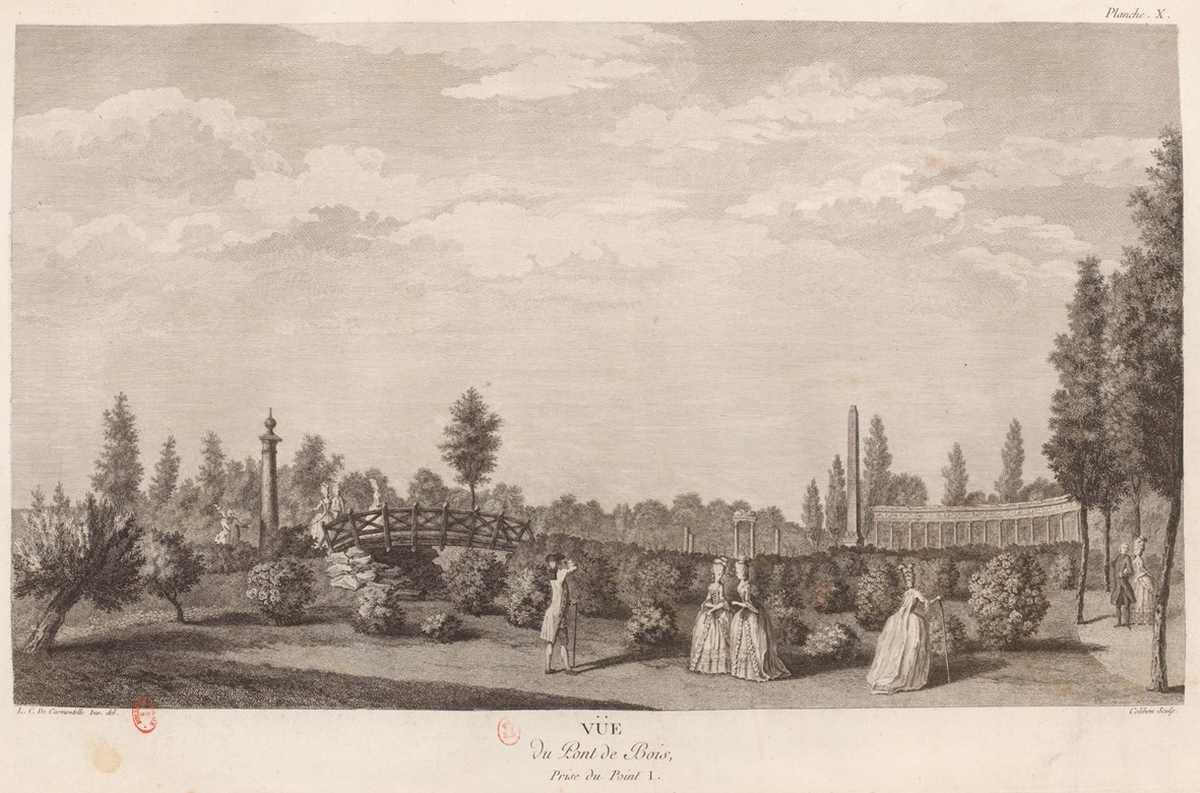
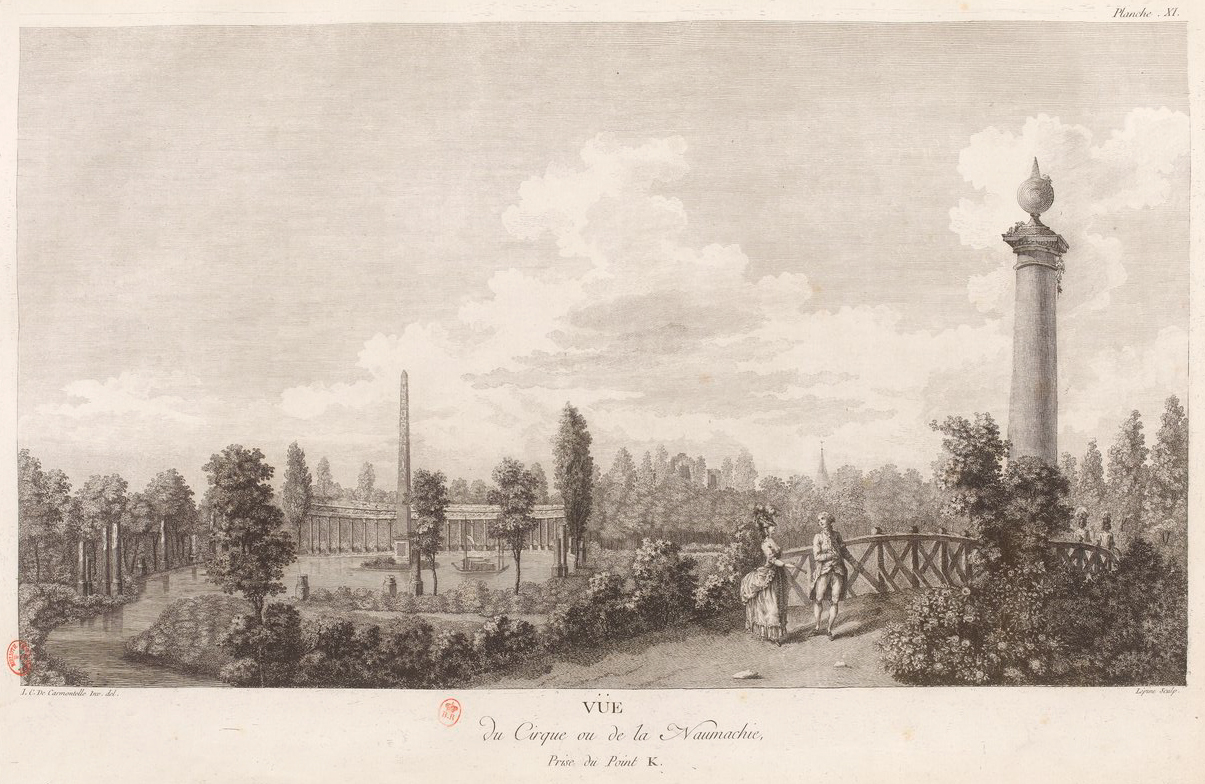
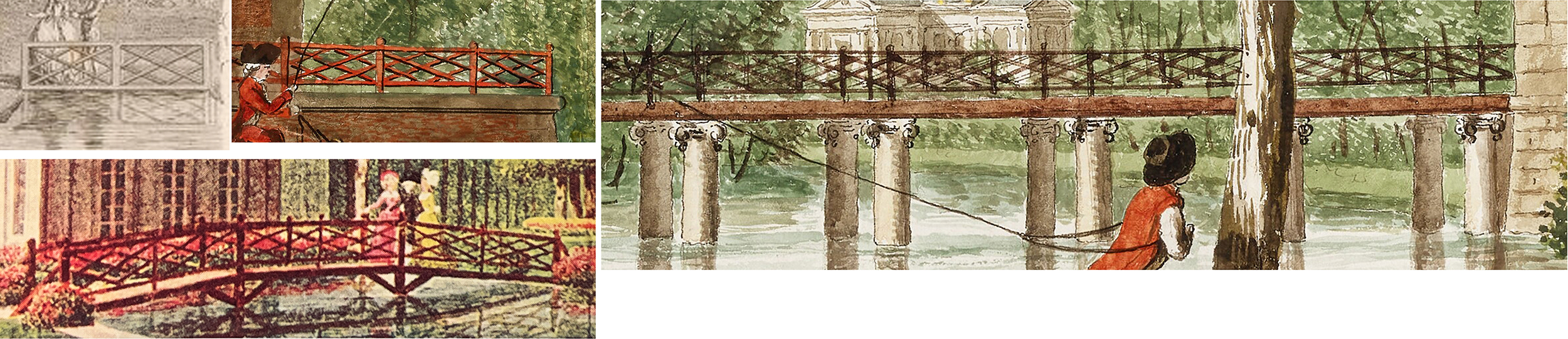
This is of a traditional design that sometimes gets called Chinese but is based on Palladio’s representation of the Roman bridge over the Rhine. This was a highly practical bridge design, which is why the Romans invented it, as it consists of a series of rectangular panels made from posts, rails and cross-bracing which form simple trusses. These are joined together in a shallow arch, combining the structural virtues of arch and truss. Usually they have cross-beams that extend laterally to form outriggers supporting braces for the posts, although in Carmontelle’s bridge there are instead short diagonal braces on the inside, which would have done the job of bracing the posts at the cost of being a trip hazard. This design was practical because it could be made of short pieces of timber, although the top rail could often be achieved using a single piece of bent wood (Figs 9, 11).
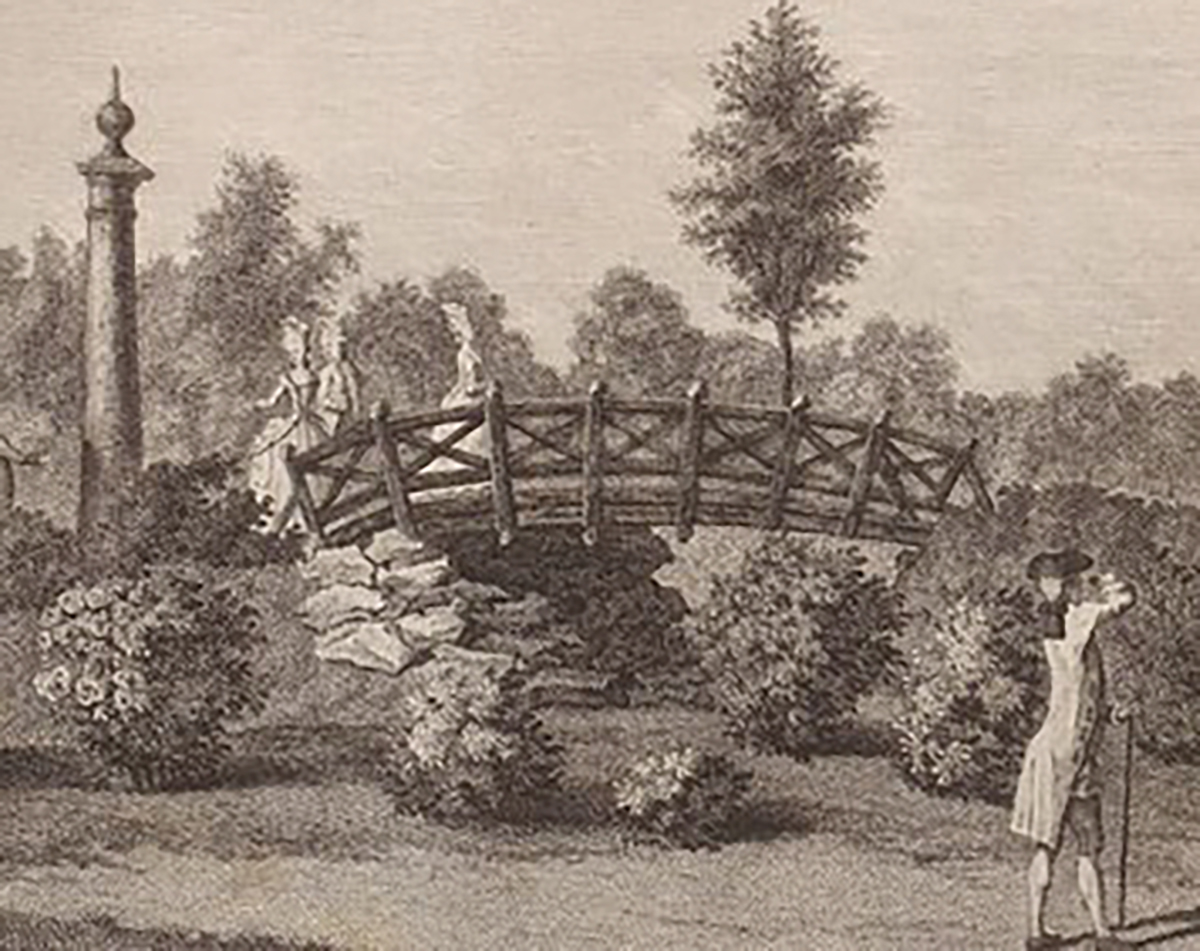
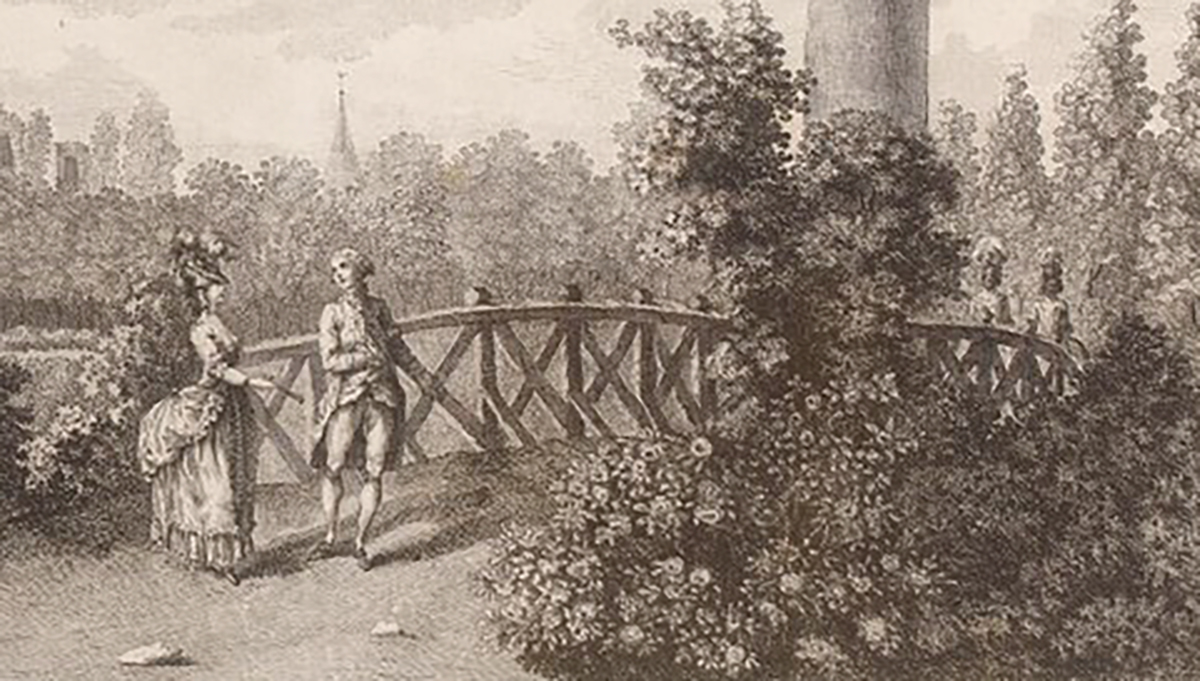
The design of the ‘Pont du Bois’ has nothing to do with China, as Carmontelle was well aware, and he only refers to its function, as in his discussion in in Plate X, ‘Of the wooden Bridge, taken from point I’ and adjacent captions he says nothing about its style or colour. It has a milestone nearby, which may imply that he considered it to be a rustic, rural feature.
The Pont de Bois was near the Naumachia, or circus (Figs 8, 10), which, characteristically, has nothing to do with the usual visualisation of naumachiae that goes back to Pirro Ligorio. Instead, it is simply a colonnade beside a lake. Carmontelle showed little interest in antiquarianism and Italy-centred culture. He misidentifies the location of the prototype of Bouchardon’s copy of the Barberini Faun in the last plate as the Villa Borghese rather than Palazzo Barberini. Parc Monceau, as well as his transparencies (the Getty transparency rehearses the themes of Parc Monceau), show the landscape of the Ile de France, and notionally antique features, like the pyramid and the ‘Temple of Mars’ are generic forms found in gardens in the region. The various Turkish and Tartar tents are, in fact, the kind of fancy tents erected in aristocratic gardens. Similarly, he shows no interest in chinoiserie. There are, in fact, no Chinese features at Parc Monceau apart from this mysterious ‘Pont Chinois’ and the dragons and mandarins on the Jeu de Bague. When he recommends painting a bridge red it is for aesthetic reasons – because it harmonises with green vegetation – not iconographic.[2]
Nor does he use what I call ‘Chinese fret’. Carmontelle’s parapets kin the engravings of Parc Monceau and in his various transparencies,[3] are of a few simple types:
- Type 1. Cross. Two members only, which go from corner to corner (Fig. 12).

- Type 2. Cross with applied rectangle (Fig. 13).
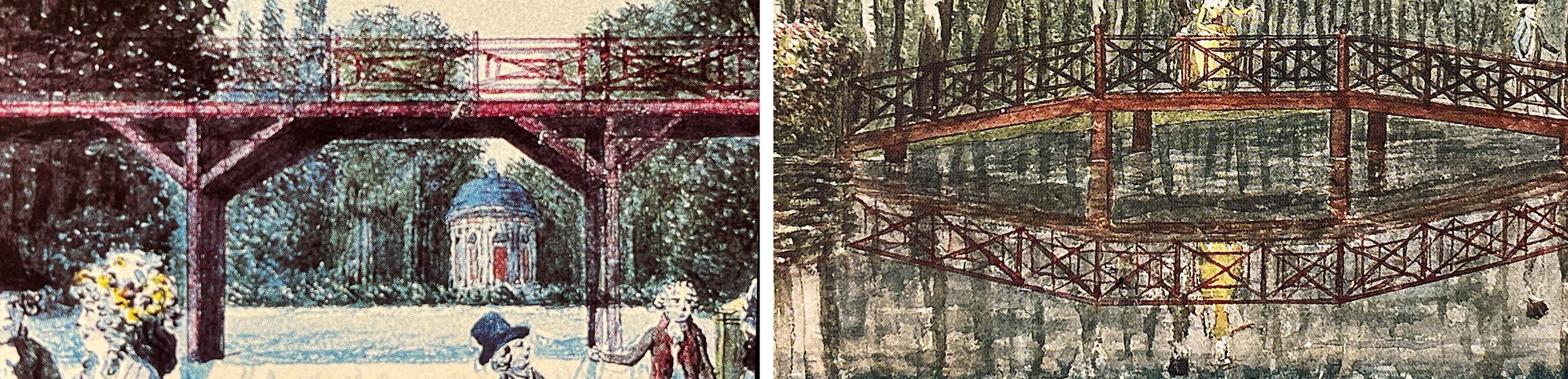
- Type 3. Lattice. Members go from corner to corner, as with cross, but there are additional members parallel to these. These can be read as forming a diamond (Fig. 14).
- Type 4. Diamond. This is like lattice but the inner members don’t reach the frame, forming a diamond. The only instance appears to be in the Jeu de Bague plate, which is called Chinese in the text, and shows the dragons at the end posts (Fig. 15).
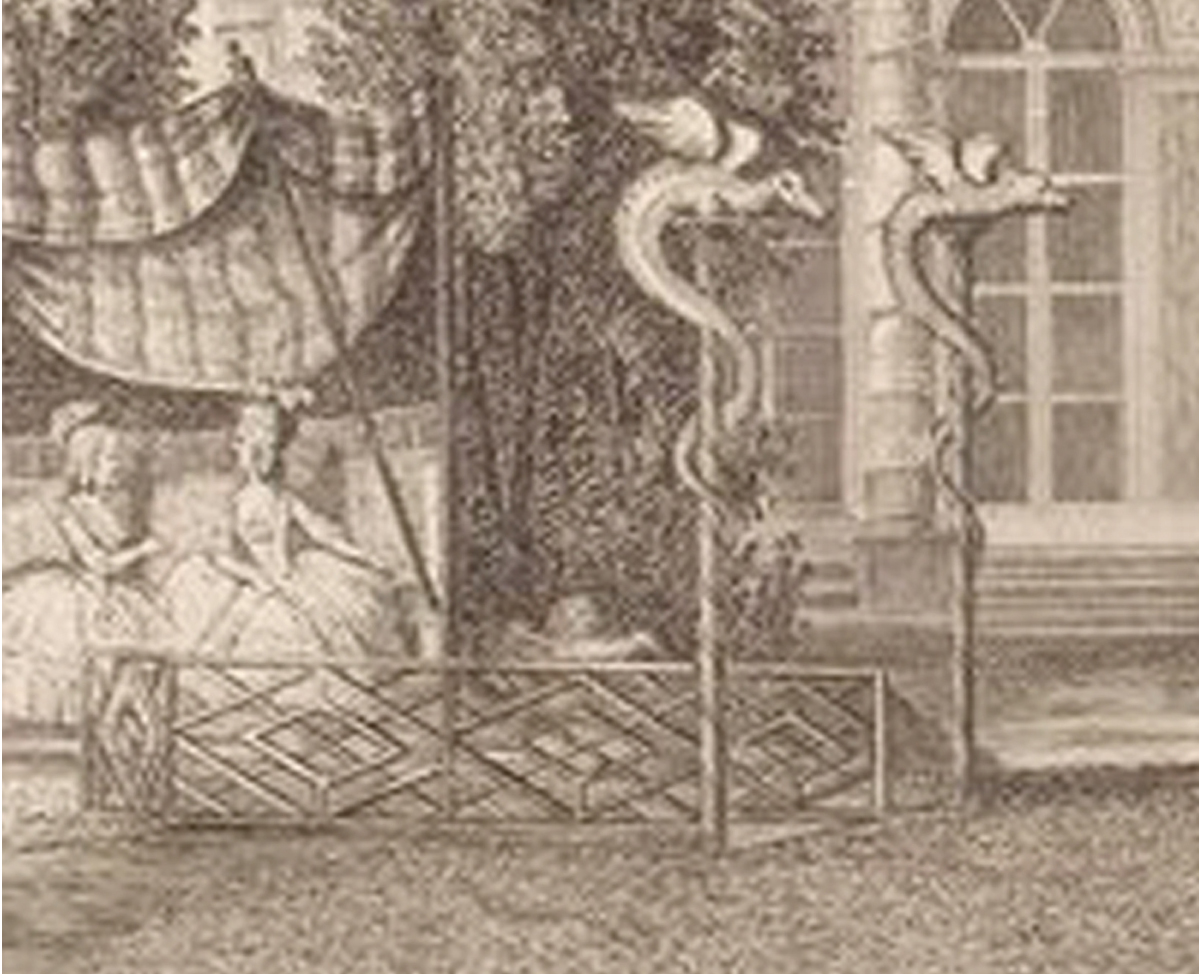
The fact that he did not employ Chinese fret, the parapet form most clearly coded as Chinese, shows how little interested he was in the theme. He does not even use it in the little ‘Chinese’ bridge adorned with dragons over the Jeu de Bague moat, as other designers would have done.
Excursus: Carmontelle on colour
It is worth exploring what Carmontelle has to say on colour in the introduction. Arguing for a scenographic garden with many features of interest (as opposed to a ‘natural’ garden), he goes off on a somewhat incoherent tangent about the colours of these features, including bridge railings, in terms of national garden styles. He starts by justifying the amount of water at Monceau, which seems to be connected in his mind with English gardens.
‘Because the rivers are fabrications in the Garden at Monceau, it was said that there was too much water in the meadows: the bridge railings, they said, should be white; because they are white in England, is that an authority? All of those in Germany are white, red and black: those of our gardens would therefore have to be painted the same if the Germans had gardens that were in fashion. In England there is a mansion built in black stone, with white pointing. Would that be pleasant to imitate? There must be harmony in gardens, and yellow and red agree better with the greenery of the different trees.’
The gist of this is that foreign fashions in colour should be rejected in favour of an aesthetic principle: that yellow and red go better with greenery than white. The following two paragraphs, if I understand them correctly, argue that in warmer climates stone has a warmer colouring, while in Germany and Flanders house materials and colouring harmonise with green foliage. In France, however, the stone is too white
[1] Elizabeth Barlow Rogers, Joseph Diponzio and Andrew Ayers, Carmontelle. Garden at Monceau, New York NY, Upperville VA, and New Haven & London: Foundation for Landscape Studies, Oak Spring Garden Fountain and Distributed by Yale University Press, 2020, henceforth Carmontelle 2020.
[2] Carmontelle 2020, p. 15
[3] Laurence Chatel de Briancon, Carmontelle’s Landscape Transparencies: Cinema of the Enlightenment, Los Angeles: Getty Museum, 2008. (English translation of the French edition, 2007

