Chestnut trees: snapping, splitting and propping

Chestnut trees are very brittle, and large branches (sometimes 400 mm in diameter) often snap in storms. I have realised that matters are made worse if branches are forced to grow upwards by being planted too close together, since the branches of trees that have plenty of space grow downwards until they reach the ground, which supports them. Hence the tree that has suffered the most fractures is the centre one of three, with the third, which is flanked on the other side by a walnut, a close second. I was starting to instal the props last autumn, but was to late for one branch of the fourth big chestnut, which is quite separate from the others. A big low branch that came close to the ground split under the weight of the crop . I had a man come to quote in lifting it with machinery so I could prop it, but by the time he arrived the top arm of the split had fractured, which the you could see the stress fracture in the lower (Figs. 1, 2). So lifting was not an option, s what I did was what I should have done in the first place, which is to prop it as it was. With spring it burst into leaf, which is hard to believe given how little of the trunk is left. Either this will peter out in the summer and die off, or else it may struggle on, perhaps with half the branches dying off In the latter case, the branch will remain as a mighty ruin.
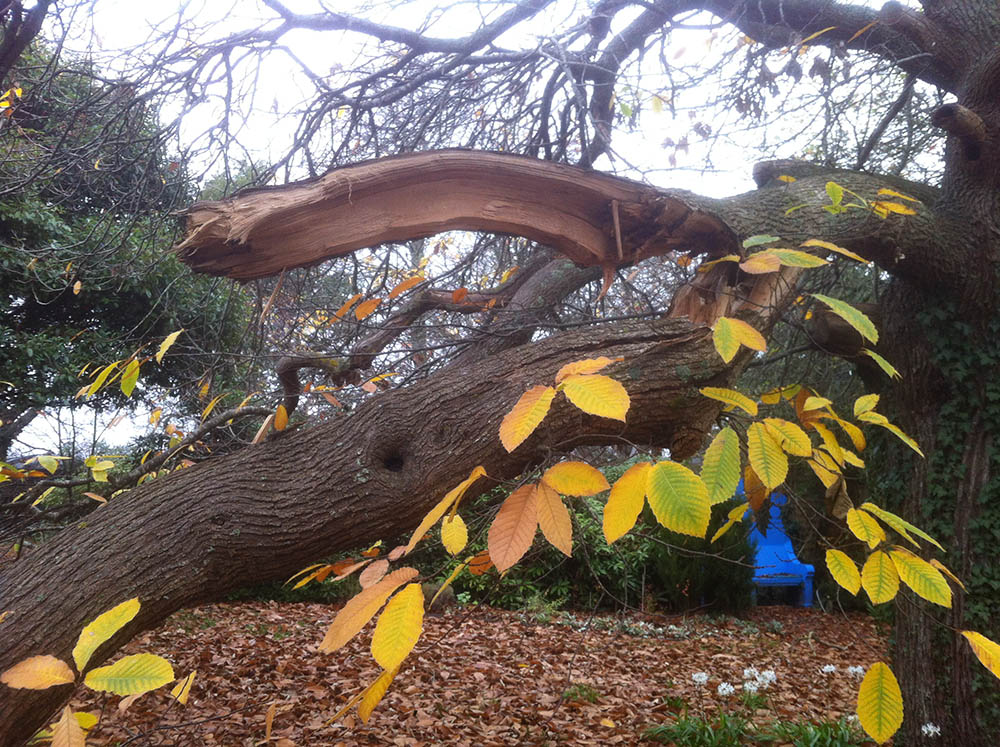
Fig_01_Split_Chestnut_A_0732_1000

Fig_02_Split_Chestnut_B_0733_1000

This really motivated me to attend to the other trees, especially the big Number One tree, which is the one that spreads the most (Fig. 3).
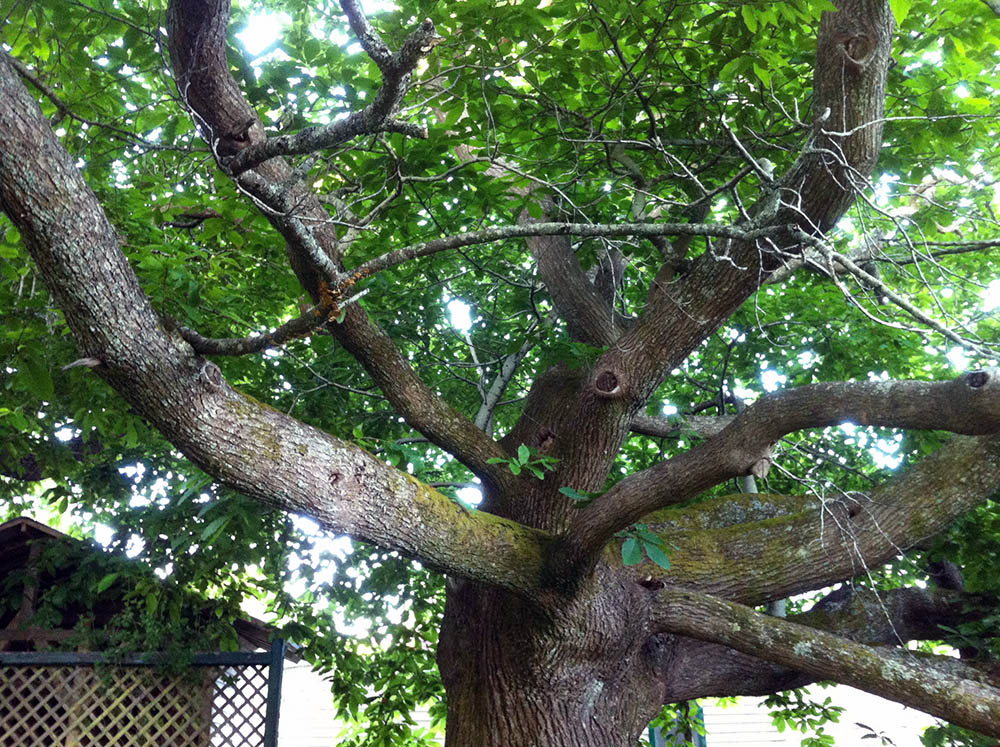
Fig_03_Trunk_1013_1000

Unfortunately, on the north side the branches cross the neighbour’s boundary. The branches on this side were lopped years ago, but have grown vertical trunks. I managed to head off the neighbour’s efforts to cut back hard to the fence line, and to get them to let me prune it more sensitively so that it is well free of their house. Fortunately they were away for a couple of weeks, so I pruned it again the other day. Seen from there side of the fence they get a wonderful leafy cave (with daffodils and bluebells beneath in late winter and early spring); the view from my side is not so good. I propped these branches. Much too big is a whopper trunk that grows upwards over the Woodshed Temple. It must be 600 mm in diameter lower down, and then goes up almost vertically at the fence line. Because it does not extend laterally very far I hope that it is secure. To prop it I would need to put a 5 metre pole up in the narrow space between Temple and fence line.

This left the south side of Number One, which has the longest branches, which extend as squiggly snakes for tens of metres (Fig. 6). There have been some fractures, but several of the branches reach the ground. Some have split, but because they were so close to the ground, the splits are not too bad. I levered these off the ground and put low props under them, partly to be able to clear around them properly (these areas have been impenetrable for years), and partly for fear that the branches resting on the ground would rot. Yet one branch could not be lifted, and seemed to have taken root (Fig. 4).=
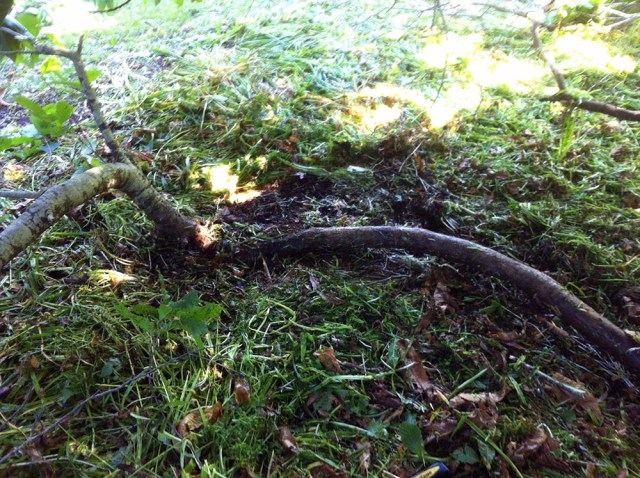
Fig_04_Rooted_Branch_1010


I was not sure if this was what really happened, until I lopped one small branch off another big one, and when I pulled it out of the ground it had roots growing out of it (Fig. 5).
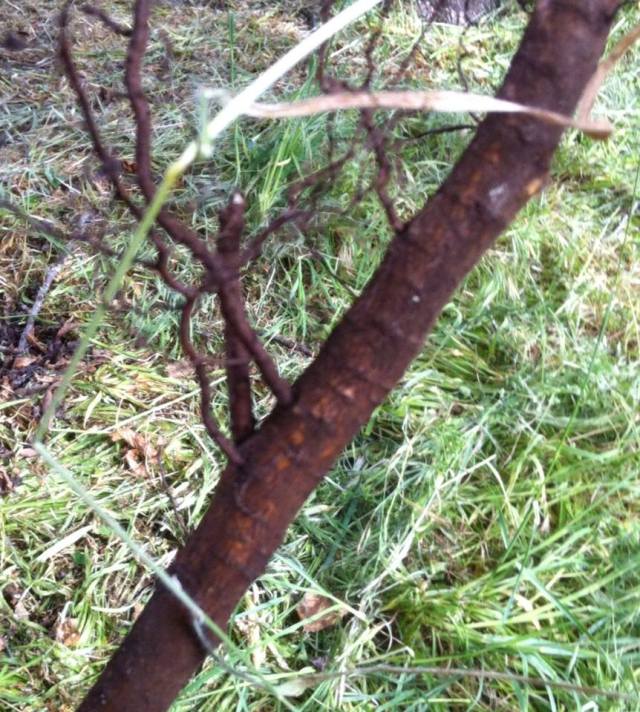
Fig_05_Root_Hairs

So it seems that chestnuts layer like rhododendrons, and theoretically could propagate themselves over a considerable distance in this way. It is very Fanghorn forest.  So my levering off the ground was actually unnecessary, and possibly harmful. The higher props, however are very necessary. The biggest worry are high branches that are 300 mm or so in diameter and extend laterally 20 m or more. One of these actually rests on another below it (Fig. 6).

Fig_06_High_Branch_1014_1000

This seems to be a breakage waiting to happen, and I am debating whether this warrants an 5 metre pole as a support. It would be both difficult to attach at the top (my ladders don’t go this high) and unsightly.

I gradually evolved a way of installing the props (Fig. 7).

Fig_07_Chestnut_Props_crop_1012_1000

These big trunks are surprisingly rigid, even 10 metres out, so are hard to lift. I look for a flat point in the right place and drop a vertical, where I place a sole plate of treated pine about 400 to 500 m long by 200 wide and 50 thick, which is dug a little into the ground. Then I measure the pole distance, plus a bit. I prop the pole at an angle and then put a strap of plastic garden edging over the branch which is screwed to the pole on both sides with hex head tek screws. (These are the only screws to use if you want to be able to disassemble things at a later date.) Then with the back of a wood splitter (i.e. a mallet) I bash the lower part of the pole and the sole plate toward the vertical, using a spirit level to get it right. This is enough to put pressure on the pole and plate to keep it all in place. Then I screw the pole to the plate, and cover the plate a bit. This is now quite firm. The trick, of course, is to do the job in winter (actually late spring now) before the chestnuts add extra weight, but at the moment the bulbs have died back and access is easier.

I measured the circumferences of the tree approximately with the metal tape (Fig. 3). It is is about 4.4 metres.
Posted in All Posts, Daylesford, Plants, Uncategorized, Villa Castagna | Tagged | Leave a comment

Highgrove’s Berninian Fabrique

A new book on Highgrove arrived today, by Bunny Guinness. I was interested to see if one feature was illustrated there—the Oak Pavilion—as it does not appear in any other book and they don’t let you take photos. Indeed, it is a high security operation. The entrance is on the road from Tetbury. There is no signage and a wall has been built across the driveway a little way back as a screen behind which lurks an army post. I had misread the instructions, which I though said to arrive not later than 15 minutes before the designated time, but it was in fact not earlier than this time. The tickets, incidentally, are hard to get. I bought the last one in January, for a June visit. It arrived by post in May, by which time I was so concerned that I would be leaving before it arrived that I wrote to them about it. There is a visitors’ centre, and you are firmly told to leave all cameras and phones in the car, and are treated to a terrifying description of trigger-happy commandos lurking in the garden to take out anyone who strays from the group or looks like a terrorist or paparazzo. Incidentally, it was interesting the way the guides were clearly uncomfortable with the fabriques. They gave lengthy disquisitions on wildflower meadows, but the fabriques were passed over with minimal comment, and with no attempt to explain them. Indeed in the woodland area there was a Bannerman fabrique that we were not being shown but could see a little way off. With another member of the group I braved the machine guns of the commandos to go and look at it—and survived.

So the Oak Pavilion feature came as a surprise. I thought it must be by the Bannermans, who have made other fabriques here, but is it by Mark Hoare. I got out a notebook to put down some keywords and was pounced by the guide and told that no sketching was allowed (though I was not trying to sketch). Memory is always misleading, which is why I hate gardens, houses or museums where you can’t take photos. In this case my memory had registered huge green oak arches and a huge wooden obelisk, but not the wavy shingled roof that is more prominent in the photos. The reason for the structure was that a cypress tree had died, and this was a kind of memorial to it. A self-seeded sapling was allowed to grow through the roof, which is a touch I can relate to, although I think my remnant hawthorn growing through the Gothic Fabrique has died. Perhaps I will paint it gold.

So what we have is huge slabs of green oak carved into arched buttresses, with the obelisk mounted on this. This seemed to me then, and still does so now, to be very Berninian. Indeed, the weightless obelisk arched in the air, as in the Four Rivers fountain, is pure Bernini. But according to the book it was inspired by the spire of Tetbury church in the distance. No doubt this is so, but being Highgrove you wonder whether there is an agenda running with the naming and the narratives. Invoking Bernini would run against the Englishness that is being promoted. It is surely significant that at the Bannerman’s grandest set of fabriques, at Arundel Castle, the sources stop at Inigo Jones, and there is no acknowlegement of the highly derivative Jones’s sources in Serlio and other Italians.

Another example of this is the Carpet Garden. This I first came a cross in a book on Islamic gardens by the woman who designed, and in this context was explicitly Islamic. It was created for the Chelsea Flower Show, and then recreated at Highgrove. It is now called the carpet garden because based on one of Prince Charles’s carpets. (The Guinness book refers to ‘The Prince’, the ‘The’ always capitalised. Very pompous. I remember how you would get into trouble producing official documents at Melbourne University if you failed to capitalise the ‘the’ in ‘The University of Melbourne.) Which brings me to the Indian Gate. Presumably this can be so called because India was part of the British Empire. And is it significant that there are no Chinese fabriques, although there are occasional sub-chinoiserie elements, chinoiserie being English while China is not.

The Indian gate proved to be quite a surprise. Its sources are apparent from the outside, but possibly the reason for making it is revealed on the inside, where there is an Indian gate that is normally kept folded back and is therefore not very noticeable. This is Indian in the sense of being recently exported as decorators’ antiques from India. I have one of these, and it is much better than The Prince’s, which makes me feel good. This came from Out of India in Victoria Street, which has now gone, and the remaining pieces have retreated to the same owner’s Orient Express. Presumably these Indian antiquities didn’t take with the local clientele. The salesperson kept trying to find out what I was going to do with it: they clearly were struggling with the problem as well. I have also heard that the Indian government now blocks their export, fearing for a loss of national heritage. I don’t know whether that is true or not. Mine were bought on impulse, because the first thing that ran through my mind after seeing them was that this was just like Harold Peto circa 1900 picking up pieces of medieval masonry and sculpture for his garden, pieces today found only in museums. These gates are quite as good as anything medieval, richly carved and still coloured. They are in storage and I have a vision for them, but the difficulty is how to preserve them from the elements. I wondered whether The Prince had the same problem, and so built this gate superstructure primarily as a weatherproof installation for the doors.

Returning to the Carpet Garden, at the end of the tour I realised we had not been shown it. A little later I happened to pass the guide in the visitor centre, and I tackled her about it. She rather shamefacedly confessed to having forgotten all about it, and took me there. It turned out to be next to the visitor centre. It was rather a disappointment and I can see why she forgot about it. It was confined so a small rectangular plot, a legacy of Chelsea. The tiles are a rather suburban terracotta, with a bright blue channels. The whole lack a sense of invitation, and I had no great desire to linger there.

Prince Charles (I think I prefer that title to ‘The Prince’) gets a lot of peoples’ backs up, for a variety of reasons, but I have a lot of time for him for what he has done. He has used the resources he has inherited, and his position, to project a benign vision of what a lived life ought to be about, and few people with such resources have done as much. Whenever I am down that way I have a look at Poundbury, his ‘ideal’ suburban development at the edge of Dorchester. It is always interesting, though as it develops it is acquiring a certain coldness: the earlier parts are the most quirky and picturesque. I remember drawing it to the attention of students, one of whom decided to research the new Melbourne suburban development of Caroline Springs for as essay on ideal towns or villages. I was rather startled to discover that this, apparently, it, too, was an ideal suburb, and the developer had similar lofty ideals to Prince Charles. (I know, to put ‘ideal’ and ‘developers’ in the same sentence in internally contradictory, but this was a few years ago, and not all developers then were Malaysian conglomerates with no investment the lives of Australian citizens.)

Yet the result is so dreary. That is just the Australian Way, but part of the problem is encapsulated in a criticism made of Poundbury by one student. Namely, that such historically referential architecture could not accommodate, for ample, the necessity for a roof pitch best suited for solar panels (the same as the latitude, namely 37 degrees). But that points up where the vision of progressive Australian individuals falls down. (I have to distinguish individuals from our unspeakable government, whose only vision is the death of our decendants in runaway global warming, which is fine so long as they can wallow, like Smaug, in piles of gold for the rest of their miserable lifetimes.) Australians put a lot of effort into technological sustainability in their houses (there are three or four newsagent magazines devoted to it), but the image of the houses they produce is eather drearily suburban, drearily modernist, or at best woody-chic. The curse of modernism is that it largely succeeded in replacing image with function, or restricting imagery to a limited modernist agenda. But, as sci-fi movies discovered long ago, the future quickly dries up as a source of visual interest. That is why all sci-fi movies are retro in one way or the other, from the art deco of Flash Gordon or the sky city of The Empire Strikes Back, to the grunge industrial of the alien movies or even the retro-modernism of Oblivion. In fact we do not want to live in the future, but in a past of our choosing, which we know, or think we know. That is why all modernist architects live in Georgian houses. Although the real objection to historical referentiality is the unspeakable mock Tudor/Federation/Georgian of the newer suburbs. (Try visiting Watergardens, especially the point beyond the little roundabout where the shops end. It makes you appreciate both Caroline Springs and banal modernism. But that may be for another day.)

What Prince Charles does is turn to the past for an image of an ideal future. And this is what distinguishes his garden from a lot of much cooler English gardens, such as Jinny Blom’s Temple Guiting House, which I have only seen as illustrated in books. While I admire its cool stylish precision, yet it the end, to me, it only projects the wealth of its owners. It seems to lack an ideal vision. While the Edwardian Gardens (and their Lutyens houses) that I admire obviously were made for people just as wealthy, or more so, but what comes through is the vision of an ideal life that they project. The purpose of the owner’s wealth is to enable them to live that ideal life, and their position is implicitly generous: if they can live an ideal life, why not others? But our wealthy want only to assert their wealth, or else have no idea with what to do with their money other than inflate the scale and extent of their bad taste.

Posted in All Posts, Architecture, Art, Baroque Gardens, English Gardens, Fabriques, Town and Village | Tagged , , , , , , | Leave a comment

Neo-baroque Hobbits: Wooden Architecture and Subterranean Art Deco

I finally caught up with the second instalment of the Hobbit movie on Virgin flights to and from Sydney (half going and half returning). It was that or a choice of 6 Planet of the Apes movies. While I found the first instalment unwatchable, I actually got into the second half of the second. This was because the architectural special effects were better. (And the dwarves were slightly less irritating: Balin almost transformed himself from a joke into a character.) The whole project is so derivative of the Lord of the Rings that there is no sense of wonder, and the special effects are, on the whole, unconvincing, largely because they are too quick. James Cameron in avatar understood that you need time to digest the wonder of special effects, or they merely flick by. In Hobbit 2 the elf city is dreadful, the tackiest of sets that makes the sets and special effects of a 19 50s sci-fi movie look good.

But things look up with the lake city, which has interesting northern European woodwork everywhere reminiscent of the timber churches of Finland and Russia, or the wooden houses of the Hanseatic ports. And there was a delightful Baroque touch with Stephen Fry as the king of the lake city (a character not in the book as I recall). Stephen Fry is hammy at the best of times, and effectively destroyed the storyteller’s illusion when he appeared as a policeman in Gosford Park. But here his hamminess is in keeping with the hamminess of the whole. In one of those long lingering shots of the faces of actors trying to be expressive that Jackson is fond of using—how many times did we get the Bilbo Baggins ‘confused and worried’ expression lingering on screen, or an elf’s digitally enhanced blue eyes staring at the camera trying to convey something of his elvish nature?—Stephen Fry’s face is surprisingly mobile, and his character surprisingly interesting for a Peter Jackson character. And, of course, he was dressed up in fully Baroque king-raiment, which was rather splendid. There was a nasty little adviser lifted from the Lord of the Rings but without the point, since while Stephen Fry’s character may have been a buffoon he wasn’t, and didn’t need to be, under the adviser’s spell: he had plenty of kingly authority; it is just that he is an anachronism. Of course, you are meant to sympathise with the communistic radical Bard the Bowman (who happens to be young, energetic and handsome, rather than a boring old fart), but in their exchanges I sympathised with the king and his dilemma.

The visual effects of the dwarf city under the mountain were rather good art deco crossed with romanesque cathedral crossed with subterranean MONA (although we have been her before in Lord of the Rings). There were some nice Piranesian shots (but all gone before you could digest them). The halls filled with dragon treasure in which Smaug was buried were rather good—significantly this is a scene that is quite vivid in the book. The plotting was deeply silly and essentially padding, like the whole trilogy. We all know from the book that Smaug is brought down by Bard the Bowman over the lake city by targeting his weak point discovered by Bilbo, which is an essential part of the mythic structure of the plot. But being a movie there had to be a big battle with Smaug in the dwarves’ caves. As in Total Recall, there is some unbelievably vast machinery that is ready to go only has to be reactivated by pulling on a lever (but seemingly started up as well by Smaug’s fiery breath). The technology is basic but large scale, and seems to be gold smelting. My heart sunk at one point when suspended mine carts appeared: not the chase through mine tunnels again, having just had half an hour of barrels! But they managed to avoid most (if not all) of that cliché.

By implausibly elaborate means this all results in Smaug being confronted by a giant gold statue of a dwarf king, which then melts and fills a vast hall with liquid gold in which Smaug disappears. Then he pops up again all gilded, looking like he had hopped off a chinoiserie garden pavilion. This makes him mean, I mean really mean, crying ‘wevenge!, wevenge! (or am I getting this mixed up with another movie?) so he flies off to attack the lake city, the gilding having disappeared. The film ends here. Talk about a phony climax! We are denied the true climax—Smaug’s attack on the lake city—and instead get much pointless (if visually arresting) fooling around with molten gold, which has nothing to do with Smaug’s downfall. Not to mention all the other loose ends. Even the middle part of a trilogy needs some kind of narrative unity. The reason why Lord of the Rings worked was that Tolkien’s plot was watertight, and this carried you over any Jacksonian tackiness of staging. In The Hobbit Jackson and his collaborators are stuck with having to be faithful to a rather thin plot and jazzing up the spectacle. The result is a great deal of plot irrelevance, whch makes you lose interest in the spectacle.

Incidentally, the art historian in me wants to work backwards from the movie to create an accurate ‘restitution’ (to use Pierre de La Ruffinière du Prey’s favourite word) of what the dwarf palace was really like. But I guess architectural consistency is too much to expect.

Posted in All Posts, Movie Commentaries | Tagged , , , , , | Leave a comment

On Garden Sculpture: Giant Milk Crates

Gardens are the acid test of sculptural genres. One popular genre is the overscaled object, such as the giant milk crate currently proposed as a public sculpture in Sydney. The Sydney Morning Herald tracked down the designer of the original milk crate (see link below). It is interesting how this interview never mentions the difference in size between sculpture and original. From the art point of view the change in scale is everything. Equally interesting is the way the artistic justification for the ‘over-scaled everyday object as work of art’ has dropped out of sight. I think the first person to do this was Claes Oldenburgh, and in everything I ever read about him the ‘justification’ was essentially its place in the triumphant march of American modernism. But where does it leave things today when the OSEOAWOA has become a regular genre? One commentator asked what was the difference between this and the ‘giant pineapple’ or ‘giant wool bale’. Quite so. Insofar as there is one, it lies in the audience to which it is addressed. The giant pineapple/wool bale is a simple celebration of the dominant product of a district. The giant milk crate is not. By being labelled ‘sculpture’ and ‘art’ it is situated, notionally if not physically, in an art gallery, which situation, custom dictates, means that it is to be understood as an ironical commentary on contemporary urban life. Or something ….

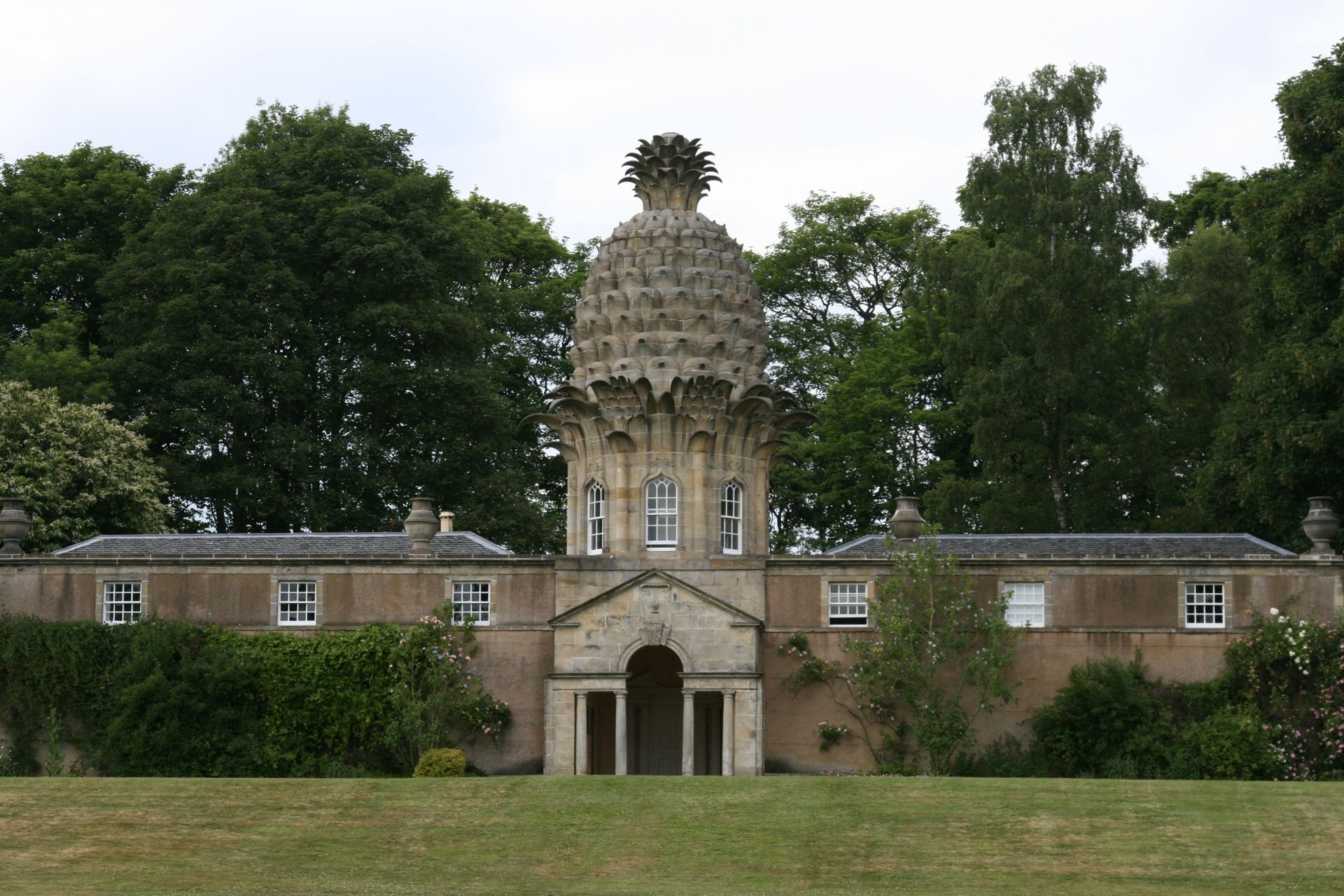
This prompts a thought experiment. Suppose that the giant milk crate is situated on the site of the original plastics factory that produced them. Then it would be part art, part heritage monument, a statement by us, now, about us/them, then. But now suppose that the factory is still operating. Then it would be just a shop sign or giant pineapple. And notice how, in our post-Duchampian world, no-one, least of all the original designer, makes a claim for aesthetic value. There is none of the shakerish worship of the humble industrial artefact as beautiful object. And that is the curse of Duchamp. Once we shake off the arid demand made by the situation to respond to it as ‘art’, we are left only with scale. The giant pineapple may actually have more to offer. The concept may be trivial, or at least simple, but there is nothing wrong with that. It is the execution that is everything: the way the pineapple has been translated into sculptural form. A good example of this is the Dunmore Pineapple, a fabrique in the form of a pineaple at Dunmore Park in Scotland. But the Duchampian milk crate denies us aesthetic pleasure.

And this provides us with the social key to the differences between the works. An inner city latte-sipping trendoid has been educated to valorise the Duchampian mode over all others. Those not so educated are more likely to be operating in the aesthetic mode. If the audience’s aesthetic calibration is fine, the giant pineapple is either repulsively crude, or an object of wonder, depending on the quality of execution of the object and the quality of the interpretation of the pineapple-idea. But if their calibration is crude, then the pineapple-as-aesthetic-object collapses into being just a giant pineapple, in the same way that the giant milk-crate is—and can only be—just a giant milk crate.

So for gardens: spare us the giant milk crate, but the Dunmore Pineapple has possibilities. There the pineapple is like any other architectural motif—like a Corinthian capital, which is rather like a pineapple when you think about it. But the point of the Dunmore Pineapple is that it is not a pineapple: it is a building in the form of a pineapple, which is something else altogether.

http://www.theage.com.au/entertainment/art-and-design/a-tall-order-for-the-humble-milk-crate-amuses-its-inventor-20140803-zzxn7.html

Dunmore_pineapple

Posted in All Posts, Art, Baroque Gardens, Fabriques, Uncategorized | Tagged , , , | Leave a comment

Fabriques: principles of design

A fabrique is a small garden structure that has no functional purpose, but exists only to make a visual and cultural statement. (This does not preclude it having a function, but if its form is dictated by its function it ceased to be a fabrique.) The fabrique is sometimes confused with a ‘folly’. But that noxious term must never be used to described a fabrique. The term ‘folly’ signifies a wilful and foolish extravagance that is likely to end in the financial ruin of its creator. A fabrique, by contrast is a serious building, the function of which is wholly artistic or cultural, not practical. The fact that ‘folly’ is an English term and ‘fabrique’ a French one probably says a lot about the attitudes of inhabitants of those countries toward creative artistic expression.

Typically, the fabrique is a quotation. Examples are the garden at Wörlitz, which has forty of fifty fabriques, almost all of which are representations or quotations of cultually signifacant buildings: the Pantheon, the Villa Hamilton, or the island tomb of Rousseau at Ermenonville. This tradition was continued by the Count de Beistegui at the Chateau de Groussay in the 1950s: Palladian Bridge, Neoclassical Pyramidal Tomb, Turkish Tent, Chinese kiosk and so forth. Chinese buildings are frequently the subject of fabriques. This continues to this day, but in my view is rather limiting, and can become problematic. For example, the late Stuart Rattle in his garden at Musk installed a Chinese pavilion. It really is Chinese, from a nineteenth or twentieth century park in China somewhere. Installed at Musk Farm, it is first a reference to chinoiserie fabriques in eighteenth century gardens, and through that a vision of China as the eighteenth century saw it. Or perhaps it bypasses the eighteenth century and goes direct to China. (Much the same is true of Groussay.) But in all this there is the danger of Las Vegasism: the empty copying of earlier cultural practices. Hence in my opinion a fabrique needs to be more complex. Fabriques are more interesting if it is the parts, not the whole, that are allusive. That shape might be Gothic, but it might be Moorish, or it might be something else again. This causes much puzzlement, as people expect to be able to label things, when the point of such a fabrique is that a ready categorisation is not forthcoming. Hence it is best to give them names that are not ready identifiers. This is different yet oddly similar to that other practice of naming an area of the garden after a famous site, and practice that goes back to Hadrian’s villa. That is an example of making something meaningful by naming it after something else, and this engaging with associations, and so causing you to see it as that named place. There needs to be some physical feature or features that establish the connection, but it need not be a replica: indeed, it is better if it is not. With the fabrique, it is the mental exercise of trying to place it but not succeeding that is the point. But both practices force you to engage with history, and a garden that does not do this is vacuous.

Posted in All Posts, Baroque Gardens, Fabriques, Uncategorized, Villa Castagna | Leave a comment

On Fabriques and Monstrous Future Ruins

‘Someone, he [Austerlitz] added, ought to draw up a catalogue of types of buildings listed in order of size, and it would be immediately obvious that domestic buildings of less than normal size—the little cottage in the fields, the hermitage, the lockkeeper’s lodge, the pavilion for viewing the landscape, the children’s bothy in the garden [the fabrique, in short]—are those that offer us at least a semblance of peace, whereas no one in his right mind could truthfully say that he liked a vast edifice such as the Palace of Justice on the old Gallows Hill in Brussels [or a Melbourne apartment tower like Fulton Lane]. At the most we gaze at it in wonder, a kind of wonder which in itself is a form of dawning horror, for somehow we know by instinct that outsize buildings cast the shadow of their own destruction before them, and are designed from the first with an eye to their later existence as ruins.’ (From W.G. Sebald, Austerlitz, pp. 18-19.)

This strikes me as very perceptive. I was looking at the Fulton Lane development in the city of Melbourne and did indeed experience just this reaction. It was wonder at the sheer size and bulk of the thing, overlaid with fear. The undercurrent of thought was indeed along the lines of ‘what if’: what if is fell, collapsed, decayed, or was struck by an aircraft. The fabrique, on the other hand, is indeed designed to have the kind of reaction Sebald describes: friendly intimacy, filled with reassurance, hope, and a sense of the richness of human culture. Of course, Sebald is here picking up on the idea of the ‘future ruin’, which came into circulation at the end of the eighteenth century and was taken up by Adolf Hitler, no less (according to Albert Speer’s memoirs.)

Posted in All Posts, Architecture, Art, Book Commentaries, Comment, Fabriques, Town and Village | Tagged , , | Leave a comment

Notes on Rodmarton Manor: The Circle

Kelmscott Manor is a Museum that feels like a private house, but Rodmarton Manor, curiously enough, is a private house that feels like a museum. The interiors feel oddly unlived in, even though the sofas (a sure sign of inhabited houses) are comfortably daggy. There are really only three main rooms, the middle one of which is rather too big to be cosy (with two fireplaces). The furniture pieces are all by Arts and Crafts architect-craftsmen—Gimson and Co.—and are much more refined than I imagined them to be. The rustic vernacular has been refined to an aristocratic level, as precious as the Rococo. The itinerary of the house enters from The Circle, crosses a hall, goes through the three large rooms, then up the stairs to a series of rather unlived-in bedrooms above the main rooms, and then down to the chapel at the west end, then back through the corridor. Photography in the house was not allowed, so my account of this is necessarily sketchy.

The garden is much more extensive than I expected, and the publications I had read did not give a very good idea of what the property was like. The only useful plan I known is by Simon Dorrell in Judith B. Tankard’s The Gardens of the Arts and Crafts Movement (p. 59). The car park is at the side of the holly drive. Then comes the stable yard, which spills you out into The Circle under leafy shade trees (Fig. 4). The full view of the façade with its multiple gables emerges after a moment, although the vastness of  The Circle with its concentric mowing rings is the dominant feature. It was designed ‘to look like a series of cottages on a village street’ (Tankard, p. 56), which is rather odd in a country house. As a result the façade is quite hard to read. The gables are too regular to be a village street and not regular enough for a house, as well as being the wrong pitch. Nevertheless, the main entrance is clearly signalled by a bay that projects further than the others and whose gable is out of step with the others (Fig. 5).

On looking more closely at the triple gables to the left (Fig. 6), these emerge as being more symmetrical than at first appear, as is established by the symmetrical bay windows, not to mention the two topiary loaves of bread flanking the entrance. The entranceway is modest, but again is clearly signalled, with a little cap-shaped drip moulding. The left gable, unlike the one at the right, continues down below the cornice, in a way that it a little Lutyens-like but without his energy. Likewise the main unit (Fig. 7) proves on closer inspection to be symmetrical around the central projection, with five gables in all, and two-storey polygonal bays at either end that help to disguise the change in orientation to the triple gable unit and the chapel wing (Fig. 8).

At the far left is further two-gable unit (Fig. 9), which has nothing corresponding to it on the other side other than the garden wall. Being lower than the three gables, these signal a lesser place in the hierarchy (Fig. 8). These have a calculated asymmetry in the lower windows and a transition section which effects the change of angle in plan, not this time with the polygonal hinge-like element, but with short section that rams into the front face of the wall below the first of the three gables.

Overall (Fig. 10) the building proves to have an artful asymmetry. Its underlying logic is distinct from the Gothic picturesque; the variations between components is much more calculated, more syncopated. In its intellectuality Lutyens comes to mind, but Lutyens is always more genuinely picturesque, and with a better grasp of what individual forms—gables and windows—can do. In some ways it is almost Palladian or Baroque, but there is a refusal to separate the components that we find in that those styles, not to mention the asymmetry of the whole.

Posted in All Posts, Architecture, Art, Baroque Gardens, English Gardens, Garden History | Tagged , , | Leave a comment

Tim Richardson’s The New English Garden and the Personal Intellectual Garden

I have just acquired Tim Richardson’s The New English Garden. One of his bugbears is that the art world won’t take gardens seriously as art, a theme he develops in the introduction. I was reminded of my own Gardens and the Death of Art article in Journal of the History of Gardens and Designed Landscapes (one of the world’s worst journal titles) which expresses much the same point of view, coming from the direction of the Getty Garden, though I don‘t imagine anyone has read it. Richardson is very good on explaining subtexts in the English gardening world that can baffle the uninitiated. He points out why (apparently; I did not know this) such gardens as The Laskett by Roy Strong and Julia Trevelyan Oman get the British back up—too autobiographical, too many incidents, and he’s not the right class anyway. Apparently the National Trust (in which Richardson has a role) was sniffy about taking it on (it is now a private foundation). I tried to visit it but they only take groups. It is in fact hard to find anything useful written about it, other than little articles mostly written by Strong himself, but Richardson sets it into a critical framework that would otherwise be absent.

Richardson also explains a certain sniffiness in reactions to Prince Charles’ Highgrove—not on class grounds, but because it, too, has too much incident. This is a theme that I need to return to, because the really creative gardens are not the designer gardens—which can afford to be cool and complete and not too busy because they stop at the creation stage, and the designer moves onto something else. The really interesting gardens are both personal and intellectual: Ian Hamilton Finlay’s Little Sparta (the only garden I know acceptable to the art world, because Finlay was an artist first and gardener second); Charles Jenck’s Garden of Cosmic Speculation; The Laskett, and Highgrove, all of which are highly personal creations by people who have something they want to say but don’t care whether or not they have an audience. (All, have been wholly private for much of their existence.) The fact that you can disagree with the point of view expressed is what they are all about. It is hard to disagree with a designer garden, which gradually modulates into the suburban once the garden makeover world takes notice. Naturally the creative gardens get added to and become more cluttered, because their creators don’t move on, which is what makes them interesting.

Posted in All Posts, Book Commentaries, English Gardens | Tagged , , , | Leave a comment

The Autonomous Garden

The literature on gardens always comes back to the relationship with the house. The garden associated with the house forms part of living; it is a ‘lifestyle’ thing. You get up in the morning and there it is. You may not visit its farthest reaches every day, but these are extensions of the parts you are using. The autonomous garden, by contrast, has to be visited, and to make a visit you need a purpose. There is a garden beside the road on the road to Castlemaine, which has no house attached. It was once open on an open gardens day, and although interesting as a garden, but it seemed a little lost without having a relationship with a house. There was a shed there, which became the ‘house’, but it was too negligible to adequately subsitute for one. Now if that were developed as architecture, with proper interiors that could be occupied in some way, like the ‘shy, cubic casinos’ at the Villa Lante, or, Kent’s Worcester Lodge at Badminton, then it would make more sense. To be sure, one would still not live there, but the visit would consist of establishing oneself in the ‘house’ and the garden would radiate from there. So Blomfield and company had a point.

But are there examples of satisfactory ‘autonomous’ gardens? The allotment might be considered one, but I find the allotment to be a deeply depressing concept. Its message is one of desperate escape from urban blight. The allotment disappears as soon as one has a house and yard. Conversely, one might find allotments becoming important here, as the over-population so enthusiastically embraced by our governments and property developers (same thing really) drives people into high-rise ant nests. Equally horrible is the communal sociability that apparently goes with allotments. It is the antithesis of the aristocratic solitude that the true garden should encourage. And allotments are deeply anti-aesthetic, like those TV garden commentators who declare who claim that any gardening other than growing vegetables to eat is morally evil.

Another autonomous garden is the theme-park garden. The theme-park is by definition a place that exists to be visited for a short space of time, and to be closed up at night. No-one lives in a theme park. But because it is a place to be visited, the theme-park garden generates certain pressures. We need to distinguish, however, between old gardens that now function as theme parks, and the theme-park garden proper, which has come into being to serve its theme-park purpose. Such a garden makes far greater demands of itinerary and feature. There is no place here for a quiet moment under a tree in the light of the setting sun. It has to speak to you more loudly and directly. It does so by telling an explicit story, or by representing something else in a literal way. Plants find it difficult to speak in this way, and one could argue that the theme park garden is an impossibility. It demands that you follow an itinerary, that you are told (rather than read for yourself) a story, and that a feature represents something else. You walk a route following the adventures of a Caribbean Pirate, or enter a spatial representation of the Pyramids of Egypt. Hadrian’s villa is partly theme-park garden in that it includes representations of other places; but it is also a house, and the representation explores a sophisticated mechanism of reference and association. It demands an interaction between the visitor’s own culture and the cues presented to them. The theme-park proper is a little more explicit in the point it makes.

My favourite theme-park is the mini-golf circuit in Overboard, built by the relentlessly downmarket carpenter Kurt Russell with a bit of help from Goldie Hawn. It was complete with pyramids, pagodas and so forth in papier-maché. Thought experiment: hive off, say, ‘Wörlitz’ or ‘Valsanzibio’ into separate areas and charge at the door. Would anyone come? I think not. It is not active enough. No mini-golf; no re-living stories made familiar in other media, no literalness of representation.

Another autonomous garden type is the Botanical Garden. At least there is no question whether this is or is not a garden. This type of garden it is, is, in the end, an English country house garden, part landscape garden, part flower beds. Locally it as been successful to the extent it approaches such gardens. The Botanical Gardens in Melbourne work because they are Stourhead-by-the Yarra, thanks to Guilfoyle. Yet the scientific botanical garden no longer has much pulling power. Knowing that one tree is a different species from another does not cut the mustard. Indeed, I find the excitement over the Wollemi pine to be rather sad. It suggests that people still have the mindset of the Victorian plant hunters who provided the intellectual framework for the Victorian botanical garden. Satisfaction is to be had when a new plant is discovered and propagated in a new environment. It is a cultural activity characterised by diminishing returns; the excitement over the Wollemi  pine is excitement over the fact that those returns, after running at zero for some time, have jumped to 1. The Wollemi pine represents the last stand of the Gardenesque.

The Wombat Hill gardens are less successful that the Melbourne Gardens because they are more von Müller than Guilfoyle. One can admire the tall trees and fresh air and one or two views, but if you ask for anything more you will be disappointed. If you are looking for that indefinable magic that marks the great places of the world you won’t find it there. There is no structure, no itinerary, no fabriques. Just botany. Yet Botanical Gardens, thanks to our nineteenth-century forebears, does exist in reasonably quantities, since most of the older country towns or provincial cities in Victoria with any ambition created them.

Many botanical gardens are public parks, and you could argue that the public park is a true autonomous garden. Yet is it really autonomous? They are, as the cliché goes, the lungs of a city. They are a plot within a multiplicity of residential plots. They invert the relationship between house and garden; instead of a rectangular house surrounded by garden, you have a rectangular garden surrounded by houses.

So the autonomous garden is an intriguing idea, but a problematic idea. Perhaps Alberti, the Renaissance and Baroque, and Blomfield were right in tbelieving that a garden is in the first instance architecture, and needs to be structured, both conceptually and in design, in relation to the house.

Posted in All Posts, Baroque Gardens, Daylesford, Garden History, Wombat Hill Botanical Gardens | Tagged , , , , | Leave a comment

The Garden of Bagatelle, Paris

Visit to Bagatelle, May 2011

Bagatelle was a disappointment. Partly it was the effort getting there. My guidebook rather unhelpfully listed various metro stops and left it at that, and it was off the edge of their map. I made the mistake of picking Sablons as the metro stop, since it was subtitled Jardin d’Acclimitation, which seemed a good beginning, but it was a hike of several kilometres along an unattractive, badly signposted road. For the record, you go by Metro to Porte Maillot, where there is the terminus of the 244 bus. This goes straight down the Allé de Longchamp. You get off after a few stops at Bagatelle Pré Catelan. This is in the middle of nowhere, so don’t expect visual cues. You look for the path on the same side as the bys by running of 45 degrees towards the back.  This takes you to the Grille d’Honneur. The real main entrance is on the other side, at Grille Sevres, but the Grille d’Honneur entrance is the most direct.

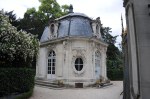
The Grille d’Honneur is a lovely rococo wrought iron gate in gold and green, which was a promising beginning (Fig. 1). Less promising was the condition of the little pavilion beside it (Fig. 2) which is derelict and boarded up. This cues you to the fact that you are in a municipal garden (Mairie de Paris) where nobody really cares. Quest-Ritson calls it the best garden in Paris, which does not encourage one to explore Parisian gardens further. (No doubt he is referring to the roses.) At the Grille d’Honneur you are in the middle of the top side of what is a long thin plot. I hadn’t had lunch so sought out the restaurant marked on the map near the Grille de Sevres on the other side. This turned out to be a wonderful nineteenth-century building, with fancy woodwork in red, and where the food was 29 euros for an entrée (Fig. 3). There was a group lunch for prosperous oldies going on. I was directed by the information woman to ‘le snack’ back on the other side. As usual in such places, the only edible things are soft drink and packaged ice cream. This seems to be the norm in France: overpriced restaurants and terrible snack booths and nothing in-between.

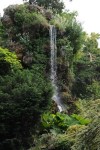
‘Le Snack’ is  near Le Grand Rocher and the central part of the Jardin Anglo-Chinois, so I started here. Le Grand Rocher is a tall construction with a waterfall coming off the top (Fig. 4). It is so like the little waterfalls you see in paintings by Claude that I think it was modelled on one. You can’t get up it (the entrance is a workplace for gardeners), but you get to see it from the front a bit further on. There were one of two people on the lawns round about, as in the Melbourne Botanical Gardens, but being so far from anywhere there were not many. The grass was yellowing and going to seed, as there was a drought on, though it was only the end of May. It was all rather Australian, and less lush than the Melbourne Botanical Gardens in summer. It make you realise how much European gardens depend on their lush greenness for their effect.

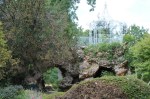
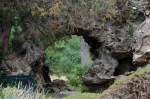
The next feature was the Grotto des Quatre Vents. This has a pale blue wrought iron pavilion on top (Fig. 5) although not the one engraved by Percier and Fontaine or La Rouge that is in all the books (Fig. 6). The grotto itself was somewhat Claudian, in the way it formed a promontory composed of two rocky arches, with the tempietto-pavilion perched on the top of the last one (Fig. 7). This motif appears a lot in early Claude, including the painting in Houston (Fig. 8). The arches themselves are composed of big, sharp slabs, and were pleasingly open and energetic; not lumpish like the rock mountain at Ripponlea (Fig. 9). Beneath the pavilion it formed a kind of cave, which would have made a good picnic room (Fig. 10). The openness and structural nature of the rockery worked well with this thinness of the wrought iron of the pavilion. In this case you could climb up to the pavilion on top. The iron is rusting, and needs maintenance before it is too late (Fig. 11). I am not a great fan of wrought iron, which tends to be thin and fussy. But this was more interesting than most, quite ethereal. The balustrades were formed by thin rods about 5 mm in diameter forming a basket weave (Fig. 12).

Down below you can see a large green copper urn on a pedestal at the junction of nearby paths (Fig. 13). Unlike Chinese fibreglass-concrete imitations, this was real copper, but it looked just as fake.

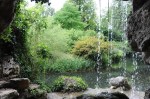
Then came is the Grotto beside the Black Swan Lake (though I didn’t see any swans of any colour). This had the conceit of being a cave you entered from behind with a waterfall sheet, or rather dribbles, screening the view of a bridge opposite (Fig. 14).  The fall landed on some rocks placed there for the purpose. Across the water you see a bridge (Fig. 15). All of these features are rather like Wörlitz, but devoid of its magic.

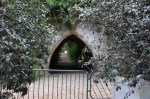
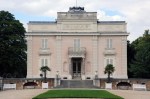
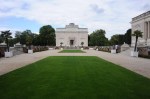
Across the bridge is the ruins of the abbey of Longchamp. I assume these are real ruins. To stop you going in there are hurdles and two trees in Versailles planters dumped in front (Fig. 16). Charming.  After that you turn right and enter a circular space framed by little pavilions faming a view of the main pavilion, grandly called the Chateau (Fig. 17). This circular space is ringed by statues, apparently the originals judging from the weathering, which include the Belvedere Antinous (Fig. 18). But you can hardly see these because of big square boards placed in front of them, seemingly waiting for posters or something, or maybe to protect the statues from ball games or something. It makes you appreciate the National Trust. There is a cour d’honneur between this and the Chateau, with another building, the Trianon, along one side. The entrance to the Trianon had a blocking structure as well (Fig. 19). Peering into the Chateau you could see a sign saying they had guided tours at 3 pm every day,  but it was 3 pm and obviously northing happening (Fig. 20). There is a parterre of tepid interest beyond, that, and other features on the north side, but I didn’t go there.

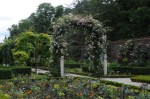
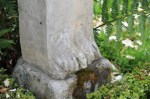
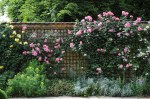
Coming past the restaurant on the west side you enter a long formal garden, the Jardin de Presentation along the boundary wall (Fig. 21). Here I met the lunch group. This was impressive. There was an avenues down the middle covered mostly with wisteria, with box beds on either side. At the entrance to the avenue were two cute little herms, about 1.4 m high (Fig. 22). They had child-faun heads (Fig. 23) and their toes peeped out of the foot of the shaft (Fig. 24). Along the boundary wall was high trellis with climbing roses. This really worked, and is something to aspire to (Fig. 25).

(to be concluded)


Posted in Baroque Gardens, Design, Fabriques, Garden History | Tagged , , | Leave a comment